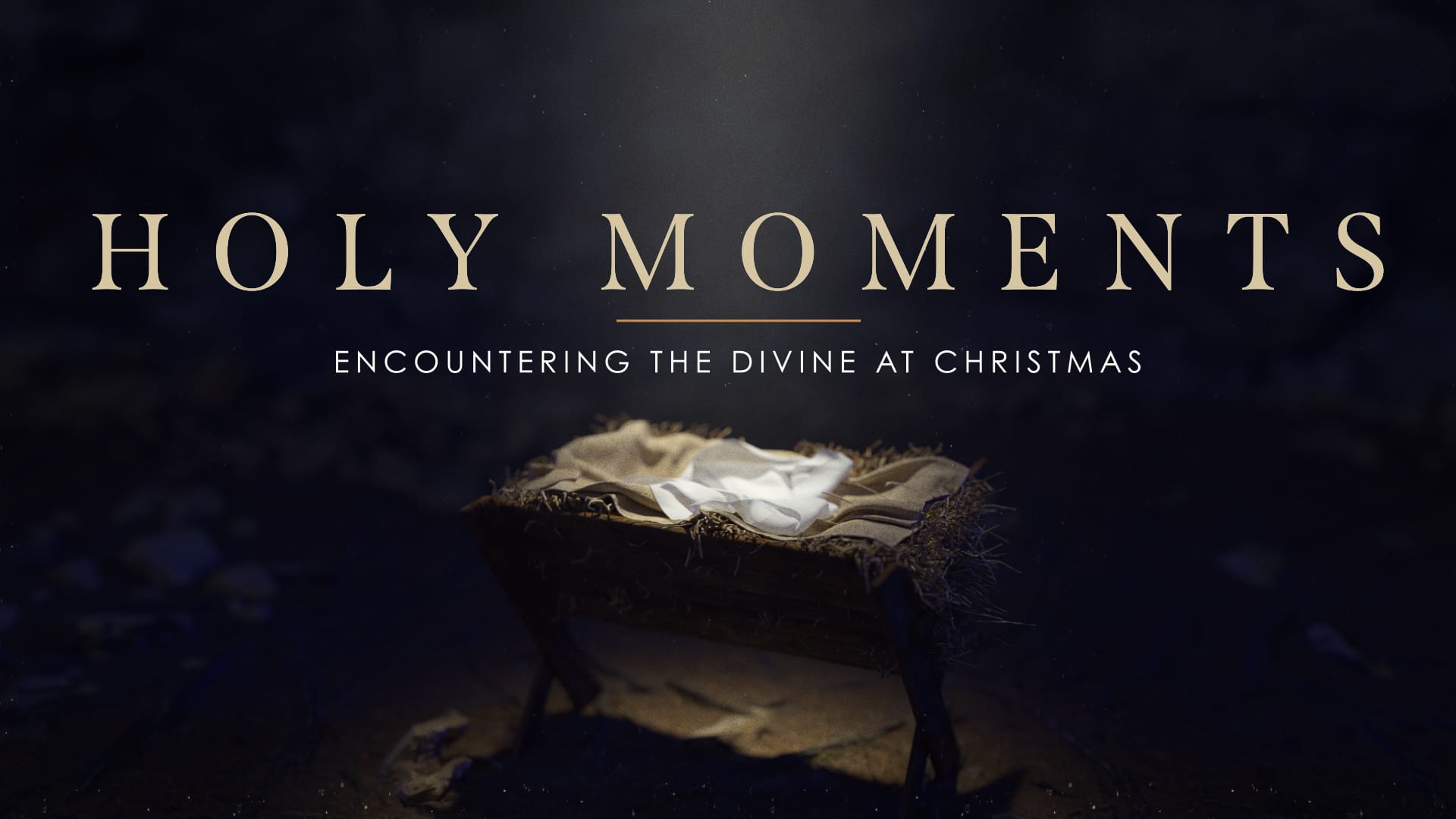
There are times when God draws near, when Heaven touches earth and life is never the same. Join us this Christmas Eve as we conclude our “Holy Moments” series and are reminded of the powerful work of Jesus both then and now.
Holy moments. God gives them to His people at the most unusual, unexpected times. If you know Jesus as your Lord and Savior, then I’m sure you know what I’m talking about.
In 2007, I experienced one of those special, memorable times at Disney World. Liz and I traveled there with our best California friends, Rick and Dennise. At the time, Rick had terminal pancreatic cancer, so while he was still somewhat functional, he wanted to travel around the East Coast and see things he loved, like Disney World.
Our day at the Magic Kingdom concluded with a concert near the base of Cinderella’s impressive, ornate castle. Who gave the concert? Chris Tomlin. Standing there in the fading sunlight, hearing wonderful worship music sung by Chris and his worship team, along with the voices of thousands of people, was a small taste of heaven.
I don’t remember which song the Lord’s presence showed up, but I do recall when it occurred and how I felt. I just knew He had drawn near. Looking at my best friend, who died one year later, I said, “Rick, who would have ever thought we’d be worshipping the Lord with Chris Tomlin at Disney World. This venue gives me an idea of what it will be like one day when we all worship around the throne of Christ.” My buddy agreed, smiling and singing his heart out. Now, we await the day when we sing and worship together in the Lord’s heavenly city. Oh, how thankful I am for a Holy Moment like this. It puts wind in your sails as you think about life.
As we’ve studied this Christmas season, the Nativity of Jesus contains numerous holy moments in which God suddenly arrested the attention of various believers. An angel named Gabriel appeared in the Temple to an old, childless priest named Zechariah, who showed up to perform his priestly duties. During that encounter, he learned that he and his barren wife, Elizabeth, a relative of Mary, would have a son in their old age who’d be the forerunner of the Messiah (Luke 1:5-25). Later, Gabriel broke into Mary’s limited-dimensional world to inform her that she, a virgin, would bear the God-man Messiah without having relations with her husband, Joseph (Luke 1:26-38). The angel even named her firstborn son for her: Jesus. Why this name? Because this son’s life mission would eventually provide the opportunity for sinners to become saints.
When it came time for Mary to give birth, she and Joseph traveled back to their ancestral town to be counted in a census decreed by Caesar Augustus for the entire Roman Empire (Luke 2:1). It must have been difficult for her at nine months of pregnancy to ride side saddle over rough, rocky, hilly terrain on a humble, bony donkey. I’m sure she felt every rock that donkey stepped on. I’m sure relief etched her face as Joseph secured some private space in a barn since all the inns in town overflowed with travelers who’d come to Bethlehem for the same regal reason. Within a few hours, the Christ child entered the world, not to the welcome of kings and statesmen, but to the baaing of a few sheep and the lowing of some restless cows. It was a holy moment, to be sure. Still, while all this transpired in the inn’s barn, another holy moment formed that night on the rolling hillsides for a group of shepherds who specifically raised sheep for sacrifice in the Holy Temple in Jerusalem.
For these faithful, hard-working blue-collar men, the night couldn’t have been more mundane.
- They clocked in as usual.
- They took turns, I’m sure, with guard duty during their shift, making sure the sheep were protected from predators or ruthless thieves bent on some easy money.
- They looked at the same stars in the cold, clear sky.
- They felt the same cold wind cut through their tunics.
- They heard the familiar noises of wild animals on the hillsides outside of Bethlehem.
- They heard the usual bleating of the sheep as their white bodies were dimly illuminated by the light beams from the faint moon.
- They struggled to stay awake as the night wore on.
And then suddenly, as with others who took part in Christ’s Nativity story, the mundane became the moment of all moments in their lives when a trans-dimensional angel moved between his multi-dimensional spectacular world into theirs. From his glorious, blinding appearance and announcement, we learn several things about the holy moments God arranges in our lives.
Holy Moments Reveal God’s Messenger (Luke 2:8-9)
God’s angel arrived at a time and place no one expected, to a group of lowly shepherds who never in a million years expected to be personally visited by a magnificent being from God’s presence. Luke, a medical doctor who understood the importance of details, paints a beautiful picture for us of this jaw-dropping event:
8 In the same region there were some shepherds staying out in the fields and keeping watch over their flock by night. 9And an angel of the Lord suddenly stood before them, and the glory of the Lord shone around them; and they were terribly frightened.
Verse 9 in the Greek text gives you no warning whatsoever that a momentous moment was about to occur for these shepherds. A simple coordinating conjunction “and” (kai) catches us completely off guard: “… and an angel.” Powerful. The shepherds did their shepherding thing, and suddenly an angel of light materialized before them. Shocking.
This should cause us to consider how close angels are to us. While we move through our daily lives, doing our typical tasks, watching our same television shows, texting on our cell phones, tweeting to our friends, spending time each day sorting through a list of e-mails, taxiing the children here and there, the angels of God are right there. Like Elisha’s servant, we need eyes to see that God’s forces surround us (2 Kings 6). As people of faith, we need to wrap our minds and hearts around the truth of Hebrews 1, verse 14 which says:
14Are they [i.e., angels] not all ministering spirits, sent out to render service for the sake of those who will inherit salvation?
The answer to the rhetorical question is unequivocally, “Yes.” Yes, they minister to us in ways we don’t fully understand and won’t know until we reach glory.
When this particular angel stepped into the physical, limited-dimensional world of the shepherds to give them much-needed revelation, you’ll note that instantly “the glory of the Lord shone around them.” What an experience in the middle of a darkened night! Only a select few have been privileged to see God’s glory.
- Israel saw the light of God in the trackless desert when He gave them the bread from heaven, the manna (Exodus 16:10).
- Israel also saw God’s glorious light when He descended on Mount Sinai to give them the Law (Exodus 24:16).
- Moses saw the glory of God as God hid him in the cleft of the rock and passed by him (Exodus 33:18).
- Israel saw God’s glory when He came down and filled the completed tabernacle (Exodus 40:34), and later, the Temple (1 Kings 8:11).
- Ezekiel saw God’s glory in all of its beauty and brightness as he was permitted to see into heaven (Ezekiel 1:22-28).
As we learn from texts like these, especially ones like Exodus 24, God’s glory, which is intrinsically tied to His utter holiness, is sometimes like a burning, raging fire of all fires:
16The glory of the LORD rested on Mount Sinai, and the cloud covered it for six days; and on the seventh day He called to Moses from the midst of the cloud. 17And to the eyes of the sons of Israel the appearance of the glory of the LORD was like a consuming fire on the mountain top. 18Moses entered the midst of the cloud as he went up to the mountain; and Moses was on the mountain forty days and forty nights” (Exodus 24).
We shouldn’t wonder, then, why the shepherds were instantly terrified. They didn’t just see an angel radiating God’s holy light. They got a peek at the light produced by the burning fire of God’s presence. And to think that this spectacular encounter happened at a mundane moment, in a mundane place. In light of this, I must stop and ask all of us a personal question: Since the glory of God is so close to us, what sort of people should we be? Certainly not ones who merely go through the motions of each day, but ones who live in light of the knowledge of God’s awe-inspiring, jaw-dropping, intimate, immanent personal presence.
Your Holy Moment this Christmas may not be an angel materializing in your home to give you a special message from God. Those events are unique. But that doesn’t mean God doesn’t give a word He wants you to consider in your spiritual walk. It may come through a sermon you hear in person or online, through a Christian podcast you listen to, a Christian book a friend gave you to read, and so on. It might even come in the words of a moving, beautifully written worship song. For me, Chris Tomlin’s “Is He Worthy” is one of those songs that speaks to my soul. It’s just anointed as we say in Christendom. For our purposes this holy evening, I trust that this worship and message will turn out to be the time when you encounter God’s messenger.
Take note, when God sends a messenger, it logically follows that there is always a message conveyed to you:
Holy Moments Reveal God’s Message (Luke 2:10-14)
Watch how Dr. Luke develops what happened next:
10But the angel said to them, “Do not be afraid; for behold, I bring you good news of great joy which will be for all the people; 11for today in the city of David there has been born for you a Savior, who is Christ the Lord. 12“This will be a sign for you: you will find a baby wrapped in cloths and lying in a manger.” 13And suddenly there appeared with the angel a multitude of the heavenly host praising God and saying, 14‘Glory to God in the highest, and on earth peace among men with whom He is pleased.’ (Luke 2)
The angel, who is probably Gabriel (Luke 1:19, 26), first gave the shepherds a practical word, and then a theological word. Seeing them shaking in their tunics, he literally says in Greek, “Stop fearing!” After this command, the angel gave them the magnificent reasons why they didn’t need to fear:
“ … for behold, I bring you good news of great joy which will be for all the people; 11for today in the city of David there has been born for you a Savior, who is Christ the Lord.”
“Good news” is from the Greek euaggelizomai (euaggelizomai) from which we get our word evangel, or evangelization. Literally, it speaks of announcing good news, more particularly of the gospel of Jesus (As used by Luke in Luke 3:18; 4:18, 43; 7:22; 8:1; 9:6; 16:16; 20:1). Here in Luke 2, the good news is tied to “great joy.” What is the “great joy?”
Before we answer this, we must first ask, “Who is the joyous news for?” First, it is for “all the people,” with the article “the” speaking first and foremost of Israel (as Jesus taught later in Matthew 10:6 and 15:24). The Messiah would come to Israel first, the Gentiles second. Paul picked up this motif later in Romans 1:16, and his evangelistic strategy on his missionary tours reflected it as well, as recorded in Acts.
What is so joyous about the news from the angel? The Savior of mankind was born in the city of David, or Bethlehem, as prophesied (Micah 5:1-4). Talk about a momentous, mountain-moving message! The Savior was born.
- God promised Adam and Eve, after they sinned and plunged the human race into sin (Romans 5:12-21), that He would one day send the Savior (Genesis 3:15).
- In Genesis 12, God moved to bring the Savior through a chosen nation, with Abraham as its first patriarch.
- In Genesis 49, verses 8-10, God revealed the Savior would come through the line of Judah among the Israelites.
- In 2 Samuel 7, God lays the groundwork for the Savior to be born eventually through the chosen line within Judah of David, the kingly line (Psalm 2; 89).
- In Isaiah 53, the prophet tells us, some 700 years before His birth, that the Savior will serve mankind by becoming man’s sin substitute.
- In Micah 5:1-2, the prophet tells us, again, 700 years before Christ’s birth, that He, the Eternal One, will be born in Bethlehem
In Luke 2, the shepherds are told that He has now arrived to accomplish His holy mission. There has never been better, more joyous news for us. We who could not save ourselves from God’s wrath against our sin by our own efforts have a Savior, who was born in time and space.
Charles Spurgeon, the great, gifted preacher from the 1800s, puts the Savior’s activity on our behalf in a most fitting fashion:
“Man is like a harp unstrung, and the music of his soul’s living strings is discordant, his whole nature wails with sorrow; but the son of David, that mighty harper, has come to restore the harmony of humanity, and were his gracious fingers move among the strings, the touch of the fingers of an incarnate God brings forth music sweet as that of the spheres, and melody rich as a seraph’s canticle. Would God that all men felt that divine hand” (Spurgeon’s Expository Encyclopedia, Volume 10:20).
Sin made us unstrung harps, incapable of playing a pleasing melody to God, but God’s Son’s birth and divine mission to the cross make it possible for us to be all the Father intended for us to be. Is this not joyous news? Is it your news? If not, the Master Harp Designer is but a prayer of faith away.
So the shepherds would know precisely who he spoke about, the angel moved from the general (a Savior) to the particular by calling Him “Christ the Lord” (Christos Kurios, χριστὸς κύριος). In Greek, the words have a melodic ring to them, plus there is no article, as you see in your English translation. Literally, the angel identifies the baby as “Christ Lord.” Without the article, we are drawn to the balance between the two concepts. The baby isn’t just any Jewish baby. This baby is the Anointed One (Christ is the Greek word for anointed), the Messiah, and the Lord God. It’s such an unusual term that it is used only once in the entire New Testament.
Let’s drill down into this concept further.
In the Old Testament, prophets, priests and kings were anointed with oil to set them apart for their holy task (for instance, 1 Kings 19:16; Exodus 28:41 29:7; 1 Samuel 10:1; 1 Kings 1:39, 45; 19:16; 2 Kings 9:6). Within historical and revelatory time, the term came to be tied to the royal line of David, and more specifically of the coming King of Kings, the Messiah (Psalm 2:2; 18:50; 84:9; 89:38, 51; 132:10, 17). It was this long-awaited Anointed One who was, according to the angel, born in the sleepy, silent little village called Bethlehem. Amazing. (For a fuller discussion about the concept of anointed, cf. the word “Christ” in Alan Richardson’s A Theological Word Book of the Bible: 44ff; or read the entry under the same title in Zondervan’s Pictorial Encyclopedia of the Bible, Volume 1:170ff).
The title, Lord, further nails down who this Messiah was/is. The Greek title kurios is the Greek equivalent of the main word for God in the Old Testament, Jehovah. Hence, when the Greek translators of the Hebrew Bible picked a Greek word to translate Jehovah, they typically chose Lord, i.e., kurios (Genesis 2:4; 3:1; 4:3; 5:29; Exodus 3:2, 4; 4:1; 5:1; 6:1, to name a few of the hundreds of instances). To pursue this further, you would need to consult Hatch and Redpath’s Concordance To The Septuagint: 800-838. That’s 38 pages with three columns of usages of this term!). Henry Alford, the great Greek scholar, sums up the meaning of this word as used in Luke two this way: “…. I see no way of understanding this kurios, but as corresponding to the Hebrew Jehovah” (Alford’s Greek Testament, Volume 2: 458). Let there be no doubt about Jesus’ identity. At His birth, He was God in the flesh, just as Isaiah and Micah had prophesied (Isaiah 7:14; Micah 5:1-4). Again, I ask, “Could there be any better news for sinful man than for God to leave the glory of heaven and be born, so that He could effectively die for our sin and restore our broken harps, as it were?” “Was any more momentous information ever given to mankind?” I think not. And it was given at the most mundane moment. How like God to catch us off guard and surprise us with news like this.
This Savior, Christ Jesus, had to be the God-man. Why? Dr. Erwin Lutzer gives us the much-needed answer:
“A sacrifice must be equal to the offense committed. Because our sin is against an infinite God, we need a sacrifice of infinite value. It follows that only God can supply the sacrifice that he Himself demands. That is the meaning of the gospel: God met His own requirements for us.”[1]
Peter drives this timeless truth home when he writes in his first letter:
18 For Christ also died for sins once for all, the just for the unjust, in order that He might bring us to God, having been put to death in the flesh, but made alive in the spirit” (1 Pet. 3). Only God could achieve salvation for us, and that is why this baby was born in Bethlehem. He was and is Christ the Lord, the Savior for sinners.
With this final message, an untold number of additional angels (the Greek word host, stratias, typically denotes an army, cf. Exodus 14:4; Deuteronomy 20:9) appeared along with the lone angel and declared in unison:
13 And suddenly there appeared with the angel a multitude of the heavenly host praising God and saying,14 Glory to God in the highest, and on earth peace among men with whom He is pleased.” (Luke 2)
Amen. Glory is due to the Most High God (Psalm 78:35, 56; Daniel 3:26; 4:2; 5:18, 21) who alone can bring spiritual peace to mankind. What must this have sounded like? Imagine millions of angelic beings chanting this statement in powerful, joyous unison. How emotionally moving it must have been?
What a momentous story! And it all came to a group of lowly shepherds going through the mundane motions of watching, caring for, and protecting sheep. God works the same way in our lives this Christmas Eve. Please think of this room as our open field. Think of the fact that God has descended and given us this revelatory word again, as we’ve studied it. He has broken into our mundane, ordinary, everyday lives and given us a momentous word.
Finally, from Dr. Luke M.D., we learn that . . .
Holy Moments Reveal God’s Mandate (Luke 2:15-20)
How are we to respond? Like the angels and the shepherds. The angels praised God for providing a Savior. Maybe a little praise is in order in your life this Christmas Eve. What did the stunned shepherds do? The final verses tell us:
15 When the angels had gone away from them into heaven, the shepherds began saying to one another, ‘Let us go straight to Bethlehem then, and see this thing that has happened which the Lord has made known to us.’ 16 So they came in a hurry and found their way to Mary and Joseph, and the baby as He lay in the manger. 17 When they had seen this, they made known the statement which had been told them about this Child. 18 And all who heard it wondered at the things which were told them by the shepherds. 19 But Mary treasured all these things, pondering them in her heart. 20 The shepherds went back, glorifying and praising God for all that they had heard and seen, just as had been told them” (Luke 2).
How many doors did they knock on looking for Christ the Lord? How many people did they wake up? And once they found Him, they wasted no time telling everyone they came in contact with (maybe in the middle of the night!) of the good news. The Savior of mankind, Christ the Lord, had been born! This is the momentous message we need to proclaim this Christmas, fearlessly, to anyone and everyone. Jesus was born in that humble stable to become the only Savior for repentant sinners.
If you know Him this Christmas, praise Him for His desire to come and endure much hardship to secure the right to forgive those sinners who come to Him in faith. If you don’t know Him, then I think it’s time to settle that situation with Him right now. Let this holy moment become a moment you will never forget because you asked Jesus to wash your soul clean of its sin and to make you a member of His eternal, glorious family. What greater gift could you receive than this?
Holy Moments. They come when you least expect them, but they always arrive with a divinely ordered purpose, as we see in this short story of the shepherds. That purpose can be stated in one concise sentence I entrust to you this Christmas Eve:
Holy Moments are divinely designed to captivate, educate, and motivate.
May all three words be true in your life this evening. May you be captivated by the wonder of Christ’s birth. May you be educated insofar as you now know who He was and is. And may this knowledge move you who know Him to praise and worship Him, and may it move you who don’t know Him, to know Him.
[1] Erwin Lutzer, Ten Lies About God (Nashville: Word Publishing, 2000), 35.