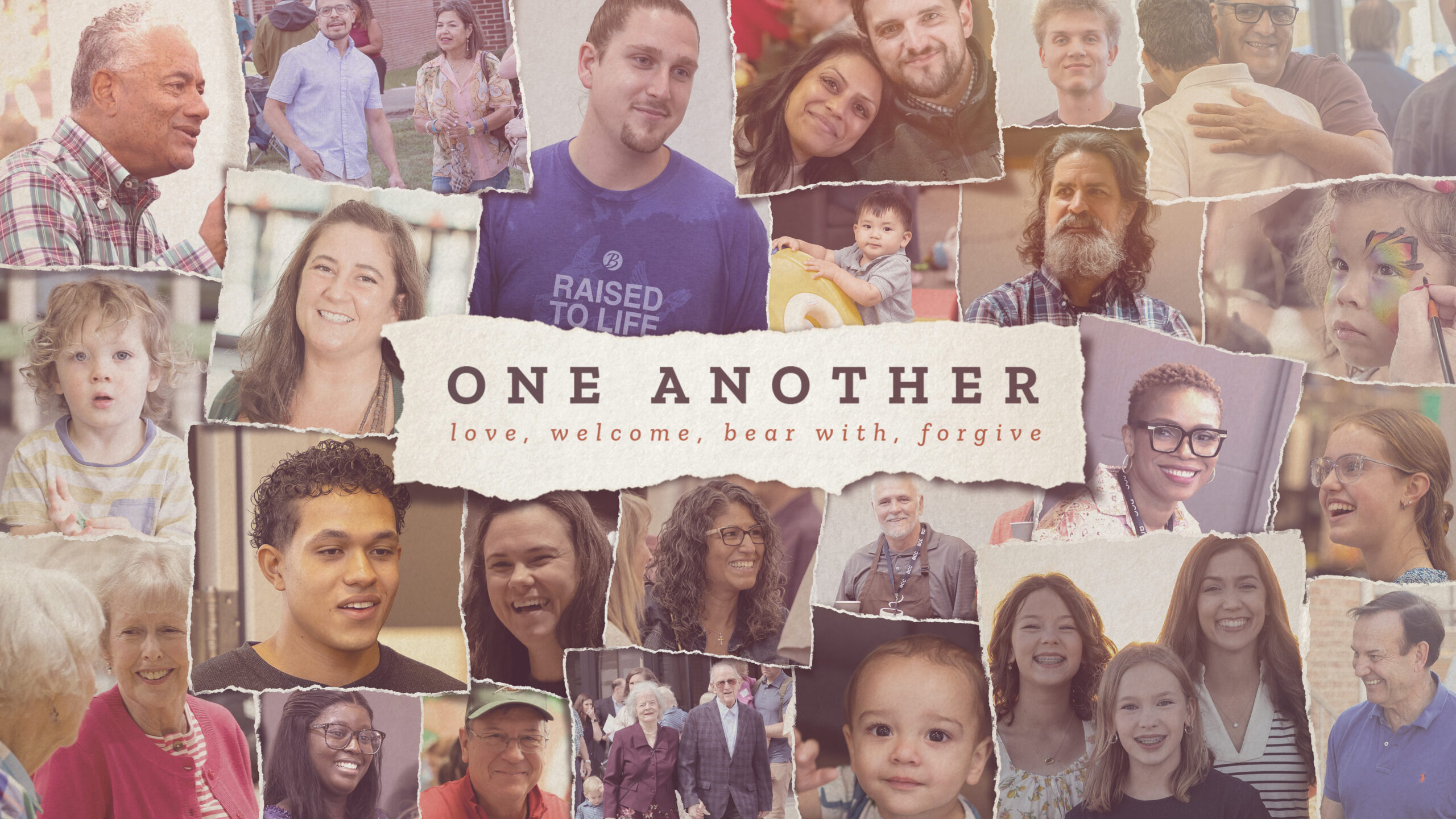
As we continue in our “One Another” sermon series we take a look at what it looks like to be kind to one another and to forgive one another. Join Dr. Marty Baker as we dive deeper into the actions and attitudes the Body of Christ is to embody and are challenged to live them out.
What is the Lord’s goal for His Church? The answer is easily found in the prayer He prayed as our great High Priest right before His crucifixion.
20 I pray not only for them, but also for those who will believe in me through their word, 21 so that they may all be one, as you, Father, are in me and I in you, that they also may be in us, that the world may believe that you sent me. 22 And I have given them the glory you gave me, so that they may be one, as we are one . . . (John 17)
Jesus prayed for His Church to be unified.
What is Satan’s goal for the Church? To sow and create division, dismay, and destruction. That’s what he did so well with Adam and Eve. He worked overtime on this strategy with the people in Noah’s day. Jacob’s twelve sons struggled with jealousy, hatred, and internal division. The people wore Moses out in the wilderness with all of their complaining, griping, and power struggles. The tribes fought among themselves even after they seized the land of promise under Joshua. The period of the kings was fraught with spiritual defection, coups, assassinations, and power plays. And who can forget how divided the people were when Christ walked the earth? No wonder Jesus prayed that the Church which would be formed on Pentecost would always strive for unity.
Why is unity so essential? Number one, it is the primary concern of Jesus, so it should be our concern individually and corporately. Number two, it is a key draw of the lost to the Church. When a local church composed of people from all races and walks of life gets along with one another in a spirit of selfless, sacrificial love, the lost take note and ultimately ask questions like, “What is going on over there?” “Can I have some of that love and acceptance?”
Since unity is so crucial to the Lord and His cause, how do we achieve it? We achieve it by pursuing those things that make a church, and the Church, healthy. Those things are what I call the recipe for church health. If you follow the fifty one other commands in the New Testament, you will make a meal of unity that unbelievers will find very attractive, and saints will want to be part of if, for sure. So, I invite you to consider one more time the pivotal question before us:
What Is The Recipe For Church Health?
Thus far, we have addressed four of these timeless commands.
- Be Loving Toward One Another
- Be Devoted To One Another (Rom. 12:10)
- Be Accepting of One Another (Rom. 15:7)
- Be Hospitable With One Another (1 Pet. 4:9)
By way of review, we need to underscore that the foundational command is the first one. If you love others, especially those of the household of faith, you will, by definition, be able to work at the other forty-nine commands successfully.
In this study, we add three more commands, not suggestions.
Be Of One Mind With One Another (Rom. 12:16)
Paul was privy to the Devil’s menacing methods towards the Church at large. Further, He had seen and dealt with it as he ministered in the local churches (Eph. 4:3; Phil. 1:27). The Roman church, for instance, struggled with class and racial distinctions and division, and this reality caused some believers to arrogantly look down upon the less fortunate, gifted, or enlightened saints. For example, from Romans 2:17-24, we can infer that Jewish saints believed they were a cut above Gentile believers. We also draw this conclusion because of the number of times Paul called the saints in Rome to be unified.
19 Let us then pursue what leads to peace and to building up one another. (Rom. 14)
5 May the God of endurance and encouragement grant you to think in harmony with one another, in keeping with Christ Jesus, 6 that with one accord you may with one voice glorify the God and Father of our Lord Jesus Christ. (Rom. 15)
Turning to more commands to impact our obedience so we would all grow in maturity as disciples, Paul added this command:
16 Be of the same mind toward one another; do not be haughty in mind, but associate with the lowly. Do not be wise in your own estimation. (Rom. 12, NAS)
Here is how the NIV translates this verse. You might find this somewhat helpful:
16 Live in harmony with one another. Do not be proud, but be willing to associate with people of low position. Do not be conceited. (Rom. 12, NIV)
The participial command here to have “the same mind” is in the present tense, denoting an ongoing obligation and pursuit on our parts. The word, phronountes (φρονοῦντες), means “being of the same mind.” It comes from the verbal root that means “to think, hold or form an opinion, to judge,” “to be intent,” “to possess certain thoughts,”[1] or “to have an attitude or frame of mind to think in such a particular way.”[2] Thus, if you have a body of people who believe a certain way about various concepts, you have unity and harmony. You also have a church.
This command naturally leads to a logical question: Does this mean we are all supposed to believe the same about all theological concepts? That is not going to happen this side of heaven. Why? For starters, some parts of Scripture are mysterious and unknown. Yeah, what is the relation between God’s election, which is clearly taught in both testaments, and man’s free will? For another, we have differing hermeneutical methods that lead to differing interpretations. Some stress the text’s grammatical and historical nature, while others claim to do so even as they spend much time evidencing an allegorical hermeneutic.
So, what is Paul getting at? I think the answer to this question is found much later, in a statement by the Lutheran theologian Rupertus Meldenius in 1627. In a tract he wrote to Christians during the volatile Thirty Years’ War (1618-1648), he gave this bit of sagacious advice: “unity in necessary things; liberty in doubtful things; charity in all things” (In necessariis unitas, in dubiis libertas, in omnibus caritas.). This is some wise counsel.
This also leads to another question: What are the necessary things? When I was a candidate for this job, I was a member of the North American Baptist denomination, the old German Baptist organization. I had been some semblance of Baptist thinking my whole life. I was raised an American Baptist and was ordained by the Southern Baptists after graduating from Dallas Theological Seminary (which I never thought would happen). As I contemplated coming here, I knew I was joining a truly non-denominational church composed of believers from various denominations. My most significant concern at the time was whether this relationship would be doable.
In talking (for hours) with the elders, they made it clear to me that we had to be united on doctrinal essentials and gracious to each other on areas where there is interpretive flexibility. Again, this led to another more pointed question: What are those doctrinal essentials? Our church Constitution details them, but for illustration’s sake I’ll mention a few: the deity of Christ, the Holy Trinity, the fact man is born a sinner, that Jesus is the only Savior and Redeemer for sinners, there will be a future judgment of believers and unbelievers, the Bible is THE Word of God and is inerrant from cover to cover, the reality of heaven and hell, to name a few. As they read and we discussed my detailed and lengthy doctrinal statement, it became clear we were united on the main doctrinal essentials. Based on that, I told them, “If we can be united, we can, by God’s power, take on Hell itself.”
At another level, we are not united on areas we deem as non-essential. We discuss and debate these areas respectfully, but at the end of the day, we are willing to die for the essentials. What things do we debate? In what areas is there some degree of mystery?
- Was the creation a literal seven-day event? I think so and can provide you with all the scientific and biblical evidence to support it, but others see it differently.
- When it comes to all of the spiritual gifts, are they all still available today, or have some ceased? I can give you all the biblical arguments for why I believe the more spectacular ones have ceased, but others see it differently.
- When it comes to Calvinism, some are what we would call five-pointers: Total depravity, Unconditional election, Limited atonement, Irresistible grace, and Perseverance of the saints. I used to be a five-pointer years ago, but after much study of areas I found problematic with the position, I’m probably a three- or four-pointer, depending on how you define terms.
I could go on, but I think you get the point. We are called, I believe, to hold to doctrinal essentials without wavering. In other areas where hermeneutical ambiguity exists, we are to be gracious, loving, and respectful toward one another. And as Paul states in this verse from Romans 12, we are never to act in a prideful, arrogant fashion, as if we are all that and a bag of proverbial chips.
For instance, the person steeped in science, like Dr. Hugh Ross, who believes God created the cosmos over millions of years and then fine-tuned it before placing man on this planet, should not think the saint who believes in the seven-day creative event is his intellectual inferior. The scientist was not present at the origin of the cosmos, so his position is, at best, a guess, and it may be way off, leading him to interpret the biblical evidence through a faulty scientific grid.
Again, Meldenius said it best: “unity in necessary things; liberty in doubtful things; charity in all things.” May your prayer, therefore, always be: “Lord, show me the difference between all of these things as I live and move in this local church. Lord, help me to always strive for unity in this body, and to never create strife over something that is not essential to the calling and function of the church.”
So, I ask you: Are you committed to be of one mind with us? If so, I pray the Lord empowers you to guard the unity Christ prayed for. Further, is there an area that you have mistaken as primary teaching, which is really secondary? If so, then ask the Lord for the power today to not permit your personal viewpoint to create disruption at any level in the body.
Another command is in order as we consider our commitment to the last one:
Be Kind To One Another (Eph. 4:32)
Here is a familiar command of Paul:
32 And be kind to one another, tender-hearted, forgiving each other, just as God in Christ also has forgiven you. (Eph. 4)
If our culture needs to see anything, it is believers who know what it means to be kind to everyone. Our culture is off the rails in this area, and they erroneously and arrogantly think their penchant for being unkind is a virtue. What is the opposite of being kind? Roget’s Thesaurus gives us some antonyms for the adjective “kind.”
[To be] malevolent, ill-disposed, ill-intentioned, ill-natured, evil-minded, malicious, rancorous, bitter, envenomed, acrimonious, virulent; unamiable, uncharitable, grinding, and galling.[3]
Just underscore that word “ill.” Folks who are unkind are sick in how they treat their fellowman.
- They gossip about you to defame and destroy you.
- They go for the proverbial jugular vein if they think you’ve done anything they don’t like.
- They never forgive and forget your human missteps.
- They bombard you with foul language, thinking this is an argument.
- They are not happy unless there is chaos.
- They are vindictive and, well, vicious.
- They never lend a helping hand, especially if you don’t hold their views.
- They never pump their brakes to let you merge into traffic.
- They drive on the shoulder so they can cut in front of you.
- They never say, “You first,” when a new line opens up at Costco or Safeway.
The believer, who the Spirit of God empowers to live differently, is commanded not to bring this type of behavior into the church, ever. But some do.
What is an unkind believer like? Let me share from experience.
- They write you nasty, biting, and degrading emails.
- They pass around information that is not true about you. At my last church, a lady told everyone, “Pastor Marty doesn’t care about the children.” Later, when we had a backyard summer club in my yard, we couldn’t find anyone to do the games, so I stepped up and served. The lady in question, who was sitting next to another member, leaned over and quietly said, “See, I told you he was a control freak.”
- They are passive-aggressive with you. One lady sought to push a heretical book on our women at my last church. She did it without my knowledge because she knew I wouldn’t agree to it being studied. When I nicely confronted her, she said, “Oh, I wasn’t doing anything. I had no idea this book was so doctrinally off.” Sure.
- They make rude comments to your face, and usually, they don’t even know they are being obnoxious.
- They say mean things to you, and they call you names. Ad hominem attacks always serve a diabolical purpose. Don’t embrace what they “anointed” say.
- They let you serve, while they always watch . . . and frequently complain about this and that.
- When asked to move during worship so others can find a seat, they stay put where they believe God has ordained they always sit.
- They included you once in a social function, but then they never did it again. They do, however, include other people that you know.
- They invite you out, but when the check comes, they are all of a sudden frozen in their chair, unable to reach for their wallet. I’ve had this happen a few times, and the worst was when the person ordered at least four appetizers, which I never do. When the bill arrived, all the brother did was smile, keep his hands under the table, and wait for me to fold. Good move for an unkind saint.
I’ll stop there because I think you get the picture. The point should be well taken: The unkind attitude of the world should not be dragged into the church. On the contrary, we should be a showcase for what it means to be kind.
What is a description of a kind saint? Here’s a short list to prime your spiritual pump:
- They offer help without you asking. They step up and step in. As one large family struggled with a tough funeral, they heard a knock at the door the morning of the funeral. Outside stood an elderly Christian man from their church. He had a wooden shoe-shine box in one hand and a smile on his face. What did he want? He wanted to shine all of their shoes before the funeral. Since their shoes were quite messy from the snow and ice they lived in, this was an unbelievably kind gesture.
- They really practice active listening because the other person matters.
- They do things that are nice and thoughtful, really, over-the-top. Illustration: The man who showed up at the family’s home to shine all their shoes as they prepared for a tough funeral.
- They are peaceful to be around.
- They aren’t explosive, but patient.
- They are thoughtful. If you happened to mention a need or something you like, they meet it later without a thought.
- They send thank-you notes.
- They say thank you when someone does something kind toward them.
- They compliment a rival when that rival achieves a victory or enjoys an advancement.
- They don’t call you derogatory, demeaning names.
- They make sacrifices to ease your load and show that they love you above all else.
- They will stand up to someone who is being unkind.
- They will protect the innocent or the bullied.
- They take the shuttle to free up space for new people to park in our busy lot on Sunday mornings.
- They step up and serve when they hear there is a definite need in the body.
- They will express kind statements toward you: I appreciate you. I like your work. I’m thankful for your service to this body.
- They will not respond to nasty emails with nasty responses.
- They hear about a need you express, and they follow up on it.
We have many kind saints among us, and I’m thankful for you, but we must never forget that Paul gave us this command for good reason. He knew that our carnal natures, at times, can pull us off course by tempting us to be unkind to each other. Don’t let that happen. Seek the Spirit’s daily control, and kindness will be the order of the day . . . and the lost will take notice because they live in a world corrupted by the sin of being unkind and ruthless to anyone and everyone.
A person who is kind is, by default, tender-hearted. A tender-hearted person is someone who understands the importance of forgiving others. They forgive because compassion drives them to do so. Yet, since some saints struggle with being forgiving because compassion is not their forte, Paul gave them, and us, this timeless command:
Be Forgiving Of One Another (Eph. 4:32)
This command logically comes at the tail end of the other two commands:
32 And be kind to one another, tender-hearted, forgiving each other, just as God in Christ also has forgiven you. (Eph. 4)
The Greek for forgiveness is chariszomai (χαρίζομαι ). If it sounds familiar, it should, because it comes from the root ‘grace’. As a verbal command, this word etymologically denoted graciously forgiving a debt that another could never pay.
Years ago, my wealthy uncle, Tony, told Liz and me we needed a larger car than my small Camaro, which he had bought me brand new when I was a Sophomore in college. We went shopping and eventually drove off the lot with a two-year-old Chevy Caprice Classic. He paid $10,000 for the loaded vehicle, and he said we could pay him off whenever we liked. However, after just a few small payments, he called me and said, “Marty, I don’t really need the money, so I’m just going to forgive that debt.” I couldn’t believe his love and generosity, but I gladly accepted it because, at the time, this was a debt I didn’t think we’d ever be able to pay on my $20,000 a year salary.
My uncle’s actions in a small way represented what Jesus did on a larger scale. He paid for our spiritual debt of sin by dying on the cross. When we approach Him in faith, He lovingly does what no one else could, or can, do: He forgives the enormous debt and sets us free. Paul says this much in Colossians chapter 2:
13 And when you were dead in your transgressions and the uncircumcision of your flesh, He made you alive together with Him, having forgiven us all our transgressions, (Col. 2).
Christ’s forgiveness of our sin was total. He did what we could never do on the cross, and when He accomplished His redemptive goal, He turned and offered us complete forgiveness and a new life with Him. What grace. What love. His action, of course, became Paul’s model of how we should forgive each other: lovingly, freely, without reservation, and without argumentation. Forgive each other, “just as God in Christ also has forgiven you” (Eph. 4). Jesus is always our model in every life situation.
What does forgiveness entail?
- You forgive, AND you forget.
- You don’t bring up the issue again, ever.
- You fully restore the person.
- You don’t tell them when they ask for forgiveness, “No, that didn’t hurt, did it?”
- You forgive what they actually did, not what you did to them. Some immature saints sin against you, and then turn and argue that you have wronged them. They arrogantly then demand repentance on your part before they can forgive you. Right. Sure.
As we live and serve Christ together, there will be times when life goes south, when something is said or done that causes hurt feelings. It’s inevitable this side of heaven because we all have clay feet. We all have moments when we don’t act like Christians. When this occurs, a healthy saint steps forward and says they are sorry, and the saint who was wronged puts their arm around the “perpetrator” and says, “Thanks, man. You know I forgive you. Let’s forget about this and move onward and upward in Christ.”
In light of this, I need to pose some questions.
- Are you holding a grudge? Against who? For what? A brother who did you wrong with your mother’s estate? A sister who is complicating the divvying up of your father’s estate? A co-worker who lied to your superior about you to cast them in a better light for job advancement?
- Who in this church body do you need to (finally) forgive of a wrong they actually committed against you? Will you go to them? What do you do if they won’t admit their wrongdoing? Move on without a bitter, retributive spirit, and continue to pray for them.
- What wrong are you nursing that someone has committed against you? Can you forgive them? Will you?
The moment you offer forgiveness is the moment you are freed from the chain that has been keeping you from joyous living. It’s also the moment that a little more Christ-horning unity is built into this body. And it is undoubtedly the last thing the Devil wants to see, so may he see a lot of it among us.
[1] Gingrich, Greek NT Lexicon.
[2] Friberg, Analytical Greek Lexicon.
[3] Peter Mark Roget, Thesaurus of English Words and Phrases (Cleveland: The World Publishing Company, 1941), 352.