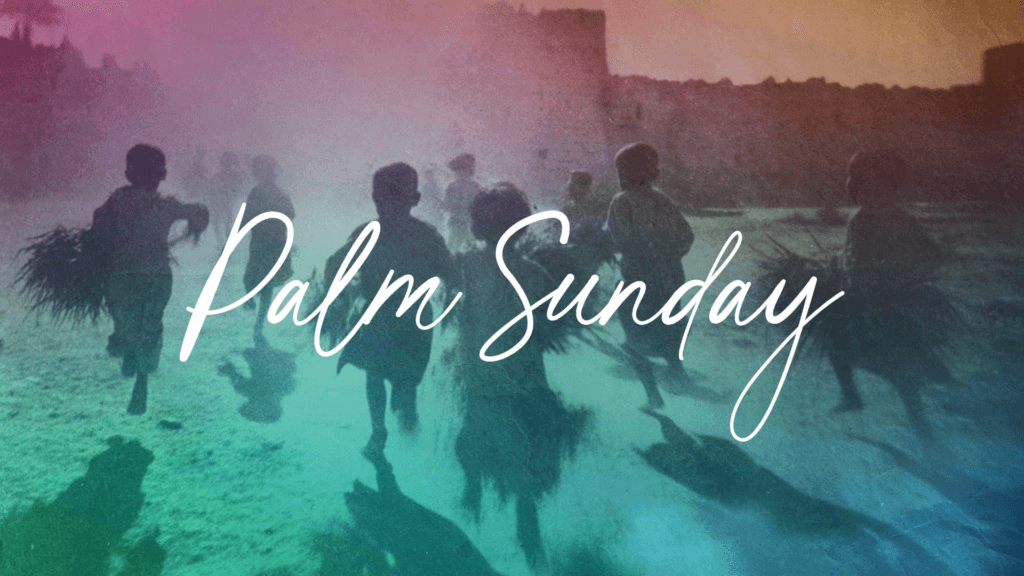
From the cries of “Hosanna” at the gates of Jerusalem, to the road to the cross and Jesus’ final breath, to the empty tomb and the promise of life beyond sin and death—these holy moments have forever changed humanity. Join us this Easter as we celebrate, remember, and step into the Holy Moments still unfolding today.
During Christmas 2025, we delved into a series titled Holy Moments. What are those? They are those special times when God showed up in our time and space and did and said amazing, never-to-be-forgotten things. Israel witnessing God descend upon Mount Sinai in all of his regal, other-worldly glory was one of those moments. I’m sure no one ever forgot what they saw and heard. God’s glory coming down from heaven and filling the new Solomonic temple was another one of those times when I’m sure the priests and the worshippers told their children, grandchildren, and friends.
If you’ve ever had a holy moment where God spectacularly revealed himself through a series of events, then you know what I’m talking about. I remember when Mel Gibson’s The Passion came out. My best friend, Rick Sealy, invited me to drive eight hours down to Saddleback Church to see it before it was released in public theaters and to hear Rick Warren interview Mel Gibson on stage. When we sat down for the viewing, we wondered why so many boxes of Kleenex were positioned on the chairs. We found out as we watched the movie. I don’t think I’ve ever watched a Hollywood movie that captured what Jesus went through in His arrest, trumped-up trials, and crucifixion to secure salvation for repentant sinners. Watching what they did to Jesus brought the most rigid, manly believer to tears. It also became one of those holy moments you will never forget because the Lord was in the room for sure.
Christ’s triumphal entry into Jerusalem on Monday, March 30, 33 A.D., certainly classifies as a holy moment. Why? Because on this day, Jesus’s ministry changed from Him being Israel’s premier divine teacher and prophet to presenting Himself as Israel’s final messianic king from the line of David, His forefather (Matt. 1). Most Israelites knew that Zechariah prophesied that the Messiah would enter Jerusalem on a donkey, and how His humble entrance would lead to Him subduing their enemies and erecting His long-awaited kingdom.
9 Rejoice greatly, O daughter of Zion! Shout in triumph, O daughter of Jerusalem! Behold, your king is coming to you; He is just and endowed with salvation, humble, and mounted on a donkey, even on a colt, the foal of a donkey. 10 I will cut off the chariot from Ephraim and the horse from Jerusalem;
and the bow of war will be cut off. And He will speak peace to the nations; and His dominion will be from sea to sea, and from the River to the ends of the earth. (Zech. 9)
Of course, no one understood at the time that this precise prophecy would have a massive time gap between verses nine and ten. They assumed the messianic and Davidic final king and high priest that the prophet had spoken about up to this point (Zech. 3:6-10, the Davidic and Messianic Branch; Zech. 6:9-13, the man, or Branch, would come and be Israel’s final King as well as High Priest) would do His redemptive and regal work worldwide when he appeared. What they didn’t grasp was that He would first offer Himself up as a humble king, and then, much later, He would return on a warhorse to dominate and destroy the forces of evil, while also establishing His prophesied Davidic empire.
So, no wonder the multitudes who had gathered to observe Passover in Jerusalem rushed with great anticipation when they heard that Jesus, the miracle-working, self-made Rabbi, teacher of all teachers of spiritual truth, who just happened to be from the line of David, rode a lowly donkey down the rocky hill called the Mount of Olives, across the small and narrow Kidron “Valley,” and up through the Eastern Gate, which in Hebrew was called Sha’ar Harahamim, or the Gate of Mercy. Freedom was in the air. Subjugation of Roman occupational forces was neigh. At last, Israel would become the global head instead of the tail, the brunt of worldwide hatred. No one, and I mean no one, who knew what was happening wanted to miss this moment. That’s why they came from all points of the compass around the old city to be part of this pivotal and prophesied time in history. All four gospels record what happened, so we will limit our recounting of the day to John’s record:
12 On the next day the large crowd who had come to the feast, when they heard that Jesus was coming to Jerusalem, 13 took the branches of the palm trees and went out to meet Him, and began to shout, “Hosanna! BLESSED IS HE WHO COMES IN THE NAME OF THE LORD, even the King of Israel.” 14 Jesus, finding a young donkey, sat on it; as it is written, 15 “FEAR NOT, DAUGHTER OF ZION; BEHOLD, YOUR KING IS COMING, SEATED ON A DONKEY’S COLT.” (John 12)
Why did they lay palm branches on the ground in front of Jesus as He approached? The seventh, and last, feast of Israel, as detailed in Leviticus, was the Feast of Tabernacles (Lev. 23:33-44). During this feast, Israel built temporary booths (Sukkah) to dwell in, remembering God’s provision during the Exodus from Egypt. Also, during this feast, the people typically recited Psalm 118, the last of the six Hallel, or praise, songs Israel sang as they went up to the Temple for worship. This song was also closely tied to Israel’s worship for the Feast of Tabernacles. Hence, it was appropriate for them to wed the palm branches with this particular Psalm because the messianic King of Kings, Jesus, was coming to town as prophesied five hundred years before His miraculous birth.
This is why we say this was a holy moment, though somewhat misguided: long before Jesus fulfilled the regal ramifications of the Feast of Tabernacles as laid out in Zechariah 14, He had to fulfill the other six feasts in chronological order.
- Passover: He had to die as our mediatorial sacrifice
- Unleavened bread: He, who would die as our sacrifice, had to be sinless, and He was.
- First Fruits: He who died had to rise from the grave so others could follow Him.
- Pentecost: He who died had to give birth to His new entity called the Church.
At the close of the Passion Week, the people went from shouting “Hosanna” to screaming “Crucify Him,” and because of this, Jesus was positioned to fulfill these first four feasts. The last three feasts await future fulfillment.
- Trumpets: The Rapture of the Church before the Tribulation
- Atonement: The Great Tribulation and the salvation of Israel
- Tabernacles: The time when the Messiah rules and reigns over the earth in a kingdom known for peace and prosperity.
The people acted prematurely. By and large, they wanted the fulfillment of the Feast of Tabernacles without having to wait for the fulfillment of the other six feasts. Jesus thought differently, but He did offer Himself as their final King if they would embrace Him.
This point causes me to ponder this particular holy moment from the angle of the massive, joyous, and boisterous crowd that day. From what I can surmise, there were basically four types of people lining the dusty, rock-strewn road from Bethany to the Mount of Olives and down to and through the Kidron Valley that day as Jesus rode the little, innocent donkey. I’m sure as we study these four types of people, you might see yourself, for the same types of people are always present as we observe and remember another Palm Sunday.
The Caught Up
Who are they? They are the FOMO people. Who are they? They live by the motto, FOMO, or “When something seems to be going down, they want to Find Out So They Don’t Miss Out. They were the folks who didn’t necessarily know a lot, or anything, about Jesus, but who just happened to be camping in the area for Passover when, all of a sudden, everyone started running in the direction of the Eastern Gate. Once there, they saw a throng of people gathered on the eastern slope of the Mount of Olives. “What’s going on up there? Why is everyone massed around what appears to be one man on a donkey? Who is he? What’s so important about him? Hey, this seems like a waste of time to be lining the streets for a Galilean on a donkey? What is with you people?”
I know the biblical text doesn’t talk about these types of people outright, but we all know they are always there for a big event. They are there because they are caught up, and they are the ones who won’t waste any time holding up their cell phones to record what’s going on, even if they don’t really know the full extent of what’s happening. They want to be part of the moment, whatever the moment is.
- If it’s a famous politician passing in their vicinity, and others swarm him, the caught up person can’t bear sitting still. They have got to get in on the action.
- If it’s a famous athlete having dinner near them, and others get up and head over to his table, they can’t sit in their seat. They’ve got to get up and see for themselves what’s going on.
- If a famous movie star happens to be in their area while on vacation, and other folks see her and mob her, the caught-up person is compelled to check out the situation. None of this, of course, suggests that the curious person is committed to changing their life over whatever important person they happen to be near, but they want to say at least, “Hey, man, I was there. Were you?”
- But a guy on a donkey is drawing this kind of crowd? Are you kidding me? “What’s so important about him? He doesn’t look like much? And you say that He our last and final king, or liberator from Roman rule? Him? Really?
I’m sure the caught-up person didn’t stick around for long after Jesus rode by. They saw and weren’t impressed, and probably headed back to their campsite to get ready for the Passover week. Imagine. They were only a few yards from the one Man who really was the future inheritor of David’s world-wide empire, as prophesied in the Old Testament, who really was the God-man as Isaiah foretold, who really was the final Sacrifice as Isaiah prophesied (Isa. 53), who really was the eternal God born in Bethlehem as Micah prophesied (Mic. 5:1-3), and none of this mattered to them. They came to see what all the hubbub was about, and then they went home unchanged and uncommitted.
Is that you this Palm Sunday? Is this not the question? Indeed, it is. You came to worship today because countless other people are doing the same. And, you know, that is what people do on Palm Sunday, but you don’t have a clue as to what Palm Sunday means, especially living in Virginia, where there is not a palm tree for thousands of miles, literally. So, you showed up today to make sure you haven’t missed anything special that might be happening. But chances are you’ll go home, have a nice lunch, and forget about the man who rode that donkey 2,000 years ago.
What you should do is go home, hit your knees, and ask the God-man who rode that donkey into Jerusalem to be your Savior and King, because that is why He rode that donkey into Jerusalem. He rode to fulfill the Scriptures that the King would first humbly offer himself to Israel. Still, after they would reject Him, as is foretold in Isaiah 53, He would become the perfect substitutionary sacrifice for our sins. Some thirty years later, Paul put Christ’s work in perspective with these words:
He made Him who knew no sin to be sin in our behalf, so that we might become the righteousness of God in Him (2 Cor. 5:21).
Jesus went from riding a donkey to bearing the cross so that you, a caught-up, emotionally-driven, sin-laden person, might obtain two precious things you could never acquire on your own effort: divine forgiveness of sin followed by the inheritance of total righteousness before a holy God.
If you are a caught-up person right now, Jesus is waiting for you to turn toward Him in faith, rather than simply walking back home because the emotion of the event has passed. Let today become the start of a new spiritual life with Him.
A second type of person we know populated the crowd that day was what I’d call . . .
The Curious
These folks knew about Jesus.
- Some had seen Him in action as a twelve-year-old, recently bar mitzvahed boy, mesmerize the greatest theological minds in the country with His insights into the Word of God. Here is how Dr. Luke recorded what happened: “46 Then, after three days they found Him in the temple, sitting in the midst of the teachers, both listening to them and asking them questions. 47 And all who heard Him were amazed at His understanding and His answers” (Luke 20). His parents had lost him in all the commotion of Passover as they headed home, so when they found Him three days later teaching the Pharisees and Sadducean scholars how to think about spiritual things, they were, well, shocked, just like everyone else who saw this exchange. And this all happened right after Passover, during the weeklong celebration of the Feast of Unleavened Bread (Lev. 23:6-8).
- Some had seen Him in action when He started His ministry by clearing the Temple of the greedy money-changers. No one had ever done this. Imagine, this was the first public ministry action of Jesus. He made a whip of cords and drove the money-changers from the holy Temple, as he flipped over their tables, poured out their ill-gotten gain on the ground, and caused their approved sacrificial animals to be driven from the sanctified grounds (John 2:13-21). The temple was supposed to be a house of prayer to the living God, not a place to make exorbitant amounts of profit on inflated prices for sacrificial animals. Who could ever forget seeing this? An unknown Jewish man from Galilee took on the entire corrupt religious authority, and no one stopped Him.
- Since Jews traveled three times a year to Jerusalem per the dictates of the Law of Moses (viz., Passover/Unleavened bread, Pesach/Chag Hamotzi in the Spring; Weeks/Pentecost, Shavuot, late Spring/Early Summer; and Tabernacles/Booths (Sukkot), in the fall, you can easily surmise that many of these worshippers had seen the miracles Christ had performed, especially in Galilee:
- Turning water into wine at the wedding in Cana (John 2)
- Healing a nobleman’s son from a distance in Cana (John 4:46-54)
- Healing a Centurion’s Servant in Capernaum from a distance because of the faith of the servant. Healing Peter’s mother-in-law and many others in Capernaum (Mark 1:29-34).
- Causing Peter and his men to catch a massive amount of fish at the wrong part of the day in the wrong part of the lake (Luke 5:1-11).
- Feeding the 5,000 near Bethsaida and the Sea of Galilee by multiplying five loaves and just two little fish from a young man’s sack lunch (John 6:1-4).
I could go on, but I’m sure you get the point. So, for about two years, thousands of people in this region personally witnessed Christ perform miracles and were exposed to His powerful, penetrating teaching. They most assuredly were in Jerusalem in 33 A.D., when Jesus rode into the city. Sure, some were believers, but knowing people, many were still simply curious.
They needed more facts. They craved more signs. They needed more proof. They wanted to ask more questions:
- What are the prophesies of the coming Messiah, and does Jesus meet these criteria?
- What miracles and signs is the Messiah supposed to pull off, and is Jesus able to do these?
- Why is Jesus on a donkey and not a war horse if he is the Messianic Davidic King of Kings?
The curious types are always present, especially at an event like this. Curious types are good to a point. They tend to be open-minded, to love facts, and to ascertain what is true versus what is false. They love to think things through to see whether they are logically consistent and valid before committing to them. They are comfortable asking many questions before making decisions.
There is a danger with curious types, however. You can go into a godless eternity with your endless questions. At some point in your search for the truth about Jesus Christ, you must make a faith statement to embrace Him or to efface Him and walk away. Curiosity might be classified as a psychological super virtue by Schooler, the distinguished professor and director of the Center for Mindfulness and Human Potential; however, it can also become a vice in relation to spiritual things when all you ever do is pose just one more question.
Are you a curious type? If so, great. Ask your questions? Why? Because God has answers. Along these lines, I’d direct you to three good books that will answer some of your questions about Jesus, the Christian faith, and the Bible:
- J. P. Moreland and Tim Muehlhoff: The God Conversation.
- Norman Geisler and Randy Douglass: Bringing Your Faith to Work.
- Norman Geisler: When Skeptics Ask: A Handbook for Christian Evidences.
Ask away, but realize that at some point, you need to come to terms with who the man was who rode the donkey into Jerusalem that day. He wasn’t just a man. He was the God-man who had come to become the Savior of sinners before He became the King of Kings.
A third group had wormed their way into the beautiful day of Christ’s pilgrimage to the Temple. I’ll call them . . .
The Combative
Dr. Luke identifies them for us. As many of the people chanted, “Blessed is the king who comes in the name of the Lord” from Psalm 118, the Pharisees, or the supposedly spiritually enlightened and highly educated in the land, yelled at Jesus:
39 Some of the Pharisees in the crowd said to Him, “Teacher, rebuke Your disciples.” 40 But Jesus answered, “I tell you, if these become silent, the stones will cry out!” (Luke 19).
What stones was Jesus talking about? Probably the stones that marked off all of the graves around the hillsides of the Temple. The Jews taught that it was in one’s best spiritual interests to be buried close to the Temple. Supposedly, on resurrection day, or the time when the Messiah would return and proceed through the Eastern Gate of the Temple, these fortunate folks would be the first to rise and walk into the kingdom of God. As such, you can hardly walk without seeing a stone-covered grave in this region. Applied to Christ’s statement, I think He told the Pharisees that if these people didn’t worship Him as the Lord God, then He would resurrect all the dead in this area, as the Messiah would and could do so that they would worship Him as the true Lord, Savior, and King of Kings. Woa.
I’m sure that retort didn’t go over well with them because in just a few days, they would arrest Jesus on trumped-up charges so they could get Him silenced forever, or so they thought.
We also know from John’s account that the Pharisees were all upset about the fact that many Jews were turning to worship and follow Christ because He had raised Lazarus from the dead. Here is what John says:
17 So the people, who were with Him when He called Lazarus out of the tomb and raised him from the dead, continued to testify about Him. 18 For this reason also the people went and met Him, because they heard that He had performed this sign. 19 So the Pharisees said to one another, “You see that you are not doing any good; look, the world has gone after Him.” (John 12).
Think about this. They had incontrovertible evidence from eyewitness accounts from reputable people that Lazarus had died and rose four days later by the simple command of Jesus. They could have even interviewed Lazarus himself because John said he attended the Triumphal Entry (John 12:9)! Eyewitnesses also worked the crowd by telling them how Jesus had, in fact, raised Lazarus from the grave by calling his name (John 12:18). Would you have worked the crowd if you had seen this occur outside of tomb of someone you knew was stone, cold dead? Of course.
But none of this mattered to the Pharisees and the Chief Priests (Matt. 121:15). Why?
- They loved power, prestige, and money more than truth and God.
- They loved darkness more than light.
- They loved the temporal things of this world and not the eternal things of the next world.
- They hated anyone who’d dare stand up to them and challenge their power and control over the people.
- They destroyed anyone they could not control.
- They sought to silence anyone who did not, and would not, agree with them.
And the man on the donkey was the object of their burning jealousy and hatred. Hence, they did everything in their power to rid the world of the likes of Him. You see the mask pulled back to expose their ugliness when they dared to arrogantly command Jesus, the God-man, to silence the voices of anyone adoring Him as the Messiah. Hold bold of them. How truly unfortunate. Their Jesus Derangement Syndrome would cost them eternal life, when it didn’t have to be that way.
Take stock of your life. Are you combative toward the man on the donkey? Do you snarl as He rides by? Does the smile on his face and the joy in the faces of His converts bother you? Does His teaching get under your skin? Does He challenge your lifestyle? Does Christ and Christianity move you to being an opponent instead of a proponent? If so, I have but a short word for you. All the evidence points to Him being exactly who He said He was. So, stop fighting against Him, and make this day the day you embrace Him in faith for fighting for you on a splintery wooden cross two thousand years ago.
Lastly, we have a group of people I identify with:
The Convinced
Who are they? They are the people who’ve considered the person, words, and proofs of Christ and have come to one definitive position: He is the true Lord, God, and Savior; therefore, I want to make Him my Lord, God, and Savior. They are the people who attended Lazarus’s funeral. They saw his mummified, rigor mortis-impacted body. They watched as the stone was rolled over the mouth of the dark, dank tomb. They wept as they walked home. No doubt, they were shocked, four days later, when they ran into him strolling around Bethany with Mary and Martha. When they heard the evidence for why he was now living and breathing, they drew the logical conclusion: Jesus was the Lord God in the flesh. Their faith was, as it should be, firmly grounded in the facts. They were in the crowd that day because they knew the divine King and the divine Savior was riding into town on a special mission. They were convinced of this fact. Are you?
For those who need a little help moving from being caught up, curious, or combative to being convinced, I share Dr. Norman Geisler’s observation about the sixty precise prophecies that were prophesied hundreds, and even thousands, of years before Christ. Dr. Norman Geisler makes this outstanding statement concerning these prophecies:
“Mathematicians have calculated the probability of 16 predictions being fulfilled in one man at one in 10 to the 45th power. If we go to 48 predictions, the probability is one in 10 to the 157th power. It is almost impossible for us to conceive of a number that big. Mathematician Marvin Bittinger, who has sold over 12 billion college math texts, calculated the probability of nine prophecies coming true of Christ at one in 10 to the 76th power. That is like picking up the same grain of sand four times in succession in a domed football stadium filled with sand.”
That would never happen, right? But in the birth, life, and death of Christ, this level of mathematically improbability did happen because He wasn’t just a man on a donkey that day. He was the God-man on a mission to become the Savior and ultimately the King of Kings. In light of this, I must ask you a personal question: Is He your Savior and your King?
Here is the story of one man who passed from unbelief to belief based on the evidence:
Ian Hutchinson, professor of nuclear science and engineering, Massachusetts Institute of Technology
I became a Christian as an undergraduate at Cambridge University, because of the person of Jesus. He was, to me, an exceedingly attractive figure for what he taught and what his life and death was said to represent. But it was only then that I heard clearly and came to accept that the evidence for his Resurrection is strong, and gives good reason to believe it is true. I also heard clearly the call to repentance and discipleship, and I accepted it. My subsequent decades of experience in the Christian faith have confirmed to me the reality of God’s presence, and my intellectual exploration has strengthened my conviction that the Gospel is supported by compelling evidence and logical arguments.
In light of this timely testimony, I think a question is in order: What are you waiting for in making a faith decision to follow Jesus Christ? Make this day your spiritual birthday. Make this day the day you have your own spiritual testimony.