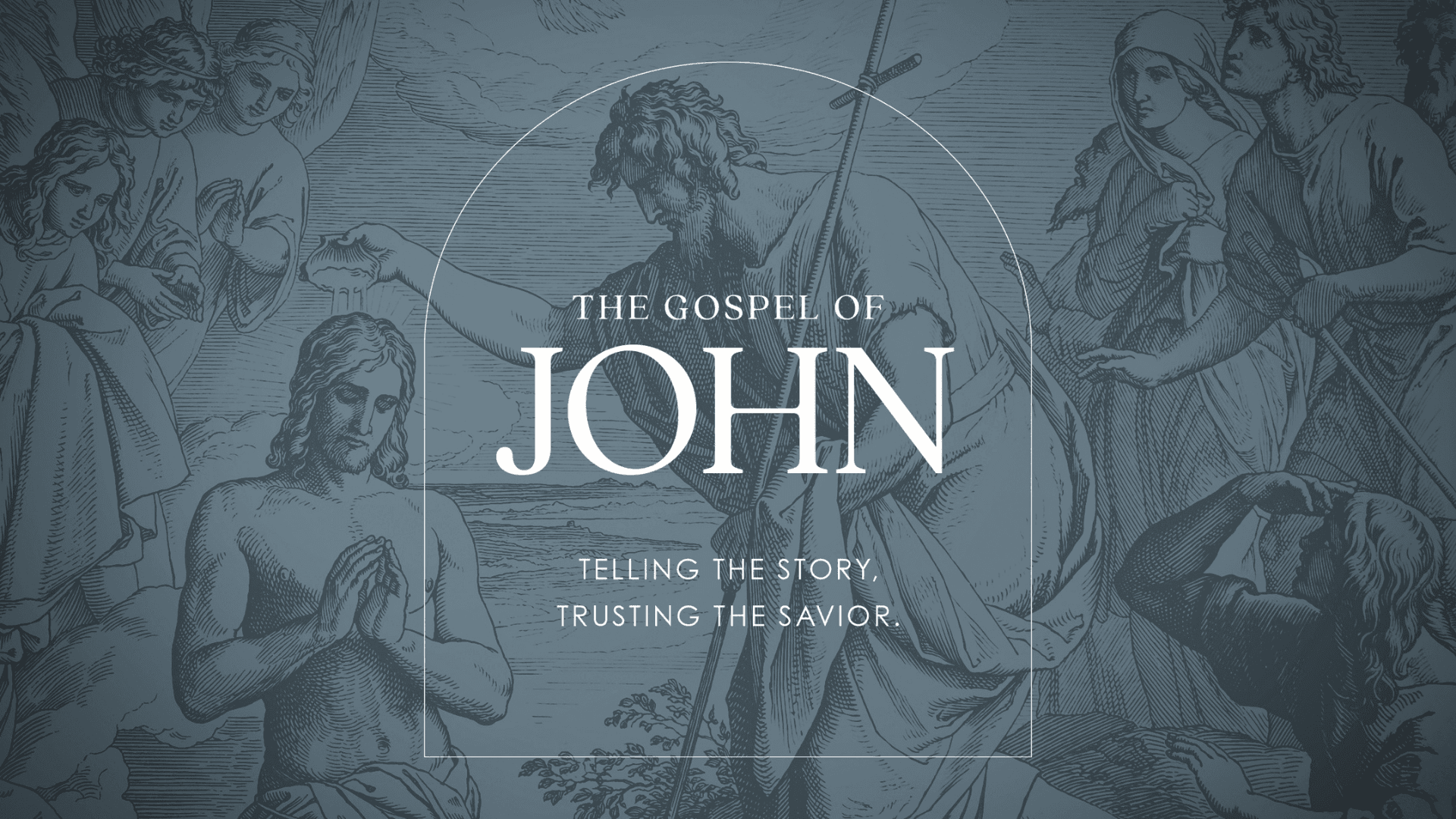
John the Baptist understood his identity and purpose: to prepare the way for Jesus and point others to the Lamb of God. In John 1:29–34, we see a life defined not by personal recognition, but by faithfully making Christ known. What can we learn from John’s example about understanding our own identity and purpose?
Starting in John 1:15, the author recounts the initial week of Christ’s new ministry. After he recalled John the Baptist’s interaction with the religious entourage that came to question him from Jerusalem, the author states how on day two, John encountered the Messiah he had just spoken about to these leaders (John 1:29). After he baptized Christ, we read how on “the next day, or day three (John 1:35), some of John’s disciples became Christ’s disciples (John 1:35-43), and then on the “following day,” or day four (John 1:43), two more men became disciples of Jesus (John 1:43-51). Then on “the third day” (John 2:1), which was probably the third day after the call of Philip and Nathanael, or the seventh day, Jesus validated His deity by turning water into wine at a wonderful wedding in Cana, located just north of His home town of Nazareth.
What is John doing with these time markers? He is methodically showing how the Messiah presented Himself to Israel and how He formed His tight-knit group of disciples who would help spread His gospel message. Pivotal to all of this is Christ’s baptism by John the Baptist in the Jordan River east of Jerusalem. Why is this pivotal? Join me as we explore a short historical paragraph that answers this question.
Why Is Christ’s Baptism So Important? (John 1:29-34)
From this short story, five answers quickly emerge. As we study them, realize they are not just given to fill our minds with who Jesus was (and is), but they, by definition, show us why we should be bold witnesses to our culture like John was. In other words, they are informational and motivational. The question we’ll conclude with will be simple to anticipate: Will you let identifying with Jesus move you to speak up and out for Him so sinners’ lives can be radically changed?
So, let’s get started. First up is this powerful concept that describes the purpose of Christ’s ministry well:
Jesus Deals With Our Sin (John 1:29)
On day two, as John probably baptized Jewish converts in the cold, greenish water of the Jordan, he looked up and saw Christ approaching. What he said at that moment puts the redemptive mission of Christ in proper focus:
29 The next day he saw Jesus coming to him and said, “Behold, the Lamb of God who takes away the sin of the world!
29 Τῇ ἐπαύριον βλέπει τὸν Ἰησοῦν ἐρχόμενον πρὸς αὐτὸν καὶ λέγει, Ἴδε ὁ ἀμνὸς τοῦ θεοῦ ὁ αἴρων τὴν ἁμαρτίαν τοῦ κόσμου.
Ἴδε, or “behold,” is emphatic and meant to arrest your attention, to get you to see that something unusual and amazing has occurred. What did John want everyone to realize? He wanted them to understand that the One he had been preaching about, the One who was coming to be the Savior and Redeemer, was now here. I know this is true because of the terms he used to identify Jesus. He called him “the Lamb of God.”
Up to this point in revelatory history, no man had ever been called this. By divine revelation to his mind, John immediately understood who his relative, Jesus, really was. He wasn’t “a” sacrificial lamb in a long line of lambs. On the contrary, He was “the” Lamb, denoted by a par excellence, or monadic, use of the article. By applying this title to Jesus, John underscored how the Lord would fulfill all the OT imagery of the lamb as it related to dealing with sin before a holy God.
- If the sacrificial animal that Abel brought to God was a lamb, and there is a good chance it was because of how God used the lamb later for redemptive purposes (Lev. 1-7), then we see how a lamb provided cleansing for one man’s sin (Gen. 4).
- The lamb that Abraham told his son, Isaac, God would provide for a burnt offering sacrifice to deal with sin (Gen. 22:8) denoted spiritual cleansing for a family.
- The lamb that God said needed to be sacrificed for that first Passover in Egypt (Ex. 12) represented God’s coverage for the sin of the nation of Israel.
- The lamb that was sacrificed in the Temple at the beginning and end of each day as a burnt offering according to Leviticus 1 represented the continual cleansing of Israel individually and nationally.
But now, according to John, redemptive history was about to change radically through this one man, Jesus. He was “the” Lamb, or the final and consummative One. After Him, no one would need another sacrifice for sin. He would put an end to the need for animal sacrifices by His personal sacrifice as the God-man. And as the God-man, Jesus was perfectly suited to be the consummative sacrifice because He was without blemish or defect (which was required of all sacrifices), meaning He was sinless (“15 For we do not have a high priest who cannot sympathize with our weaknesses, but One who has been tempted in all things as we are, yet without sin,” Heb. 4; “21 He made Him who knew no sin to be sin on our behalf, so that we might become the righteousness of God in Him,” 2 Cor. 5). Isaiah 53 prophesied of an unusual lamb who would come and bear man’s sin, and now some seven hundred years (Isaiah lived in the 8th century B.C.) later that Lamb stood before John and the nation. No wonder John exclaimed loudly, “Behold the Lamb.”
What was Christ’s purpose as a lamb? John tells us: He will “take away the sin of the world.” All of the progressive revelation concerning the use of an innocent lamb from Genesis 4 to Leviticus 1 now culminated in the work of Jesus. His sacrifice would deal successfully with the sin of the world, not just Israel’s. His redemptive work would be for Jew and Gentile.
Sin here in Greek is hamartian (ἁμαρτίαν, in the accusative). Literally, this term denoted an archer missing a target with his arrow.[1] Theologically, it denoted how Adam’s sin missed the mark/target of what God required, plunging all mankind into sin (Gen. 3; Rom. 5:12-21). We are all, therefore, sinners positionally and practically. Sin is, therefore, inherited from Adam whether we like it or not (Rom. 5:12), and it is imputed to us, or added to our spiritual ledger account, because of our relationship to Adam (Rom. 5:12-21).
Regarding our collective sinful status, John says that Jesus will be qualified to “take [it] away.” He is speaking about our positional standing as sinners before an absolutely holy God. This is just another way of saying that Jesus would be able to effectively forgive your positional sin and move you from being a sinner to being a saint, a member of His heavenly family. Religious works won’t deal with your sin. Being a good person won’t deal with your sin. Being related to godly or religious people won’t deal with your sin. Being ardently devoted to a religion that rejects the deity of Jesus won’t deal with your sin. No, only a faith relationship with the Lamb, Jesus, will take away your sinful status. In its place, from what Paul teaches later, Christ gives you His holiness (30 But by His doing you are in Christ Jesus, who became to us wisdom from God, and righteousness and sanctification, and redemption, 1 Cor. 1).
Are you misled on this point? Many are. Muslim writer Badru Keteregga teaches that everyone is born innocent, pure, and free: “There is no single act which has warped the human will.”[2] Muslim tradition echoes this teaching. Another Muslim teacher echoes these theological sentiments, “. . . people are born innocent and remain so until each makes him or herself guilty by a guilty deed. Islam does not believe in ‘original sin’; and its Scripture interprets Adam’s disobedience as his own personal misdeed—a misdeed for which he repents and which God forgave.”[3] Based on teaching like this, millions of people, and perhaps you are one of them, don’t think atonement for sin is necessary for salvation and a relationship with God. Perhaps you believe what matters is doing a good job obeying the will of Allah, or some other god of man’s making. This runs counter to what John said about Jesus. He wasn’t just a man, but the God-man, and He was, and is, the only one qualified to take away your sin, period. If Jesus is not your object of faith, then you are still in a state of sin. What you need to do is what John counseled people of his day to do: repent of your sinful status and turn to Jesus in saving faith. What or who is keeping you from making this life-altering decision?
Why is Christ’s work so pivotal? The answer is clear: He is the final sacrificial Lamb who was and is qualified to bear your sin and forgive it at your point of faith (John 3:16; 5:24-25).
Second,
Jesus Is The Eternal God In Human Form (John 1:30)
John re-emphasized the eternal existence of Christ…
30 This is He on behalf of whom I said, ‘After me comes a Man who has a higher rank than I, for He existed before me.’
Twice before this, John said that Jesus predated him. How could this be since John was six months older than Jesus? Simple, as we have said earlier. Jesus wasn’t just a man, but He was the God-man. Therefore, as God, He did, in fact, exist before John and before everything else (John 1:1: the Word was God). He was the first cause of creation, but He had no cause. He was, as we have said, purely actualized with no potentiality for existence. He was, as He will say later to the disbelief of the Jewish religious leaders, the great “I Am” of Moses (John 8:58). He could say this because it was true.
What makes Jesus so amazing, then, is that He was the eternal God who became a flesh-and-blood man, just as prophesied. The OT informed us that God was coming. Some key verses: Isaiah 7:14; 9:6; Micah 5:1-2; and Jeremiah 23:5-6 declares that the LORD will arise from the righteous branch of David. Additionally, Daniel 7:13-14 depicts the Son of Man, the Messiah, as receiving the eternal Davidic kingdom. How could His coming kingdom be eternal unless He was eternal? He was, and that revelatory truth is what blew John’s mind about his “younger” relative.
s God, Jesus could live an absolutely holy life so He would be qualified to be “the” Lamb of all sacrificial lambs. As a man, Jesus was perfectly suited to identify with us so He could bear our sin. Again, it is no wonder John made this statement a third time concerning the divine identity of Jesus. Would you have done the same? Indeed.
When I sang in Azusa Pacific University’s 50-member male chorale starting in 1976, we warmed up before concerts with an a cappella version of And Can It Be? This great song captures the import of John’s words about Jesus:
He left His Father’s throne above, so free, so infinite His grace.
Emptied Himself of all but love, and bled for Adam’s helpless race.
‘Tis mercy all, immense and free, for, O my God, it found out me.
Amazing love! How can it be that Thou, my God, shouldst die for me?
Charles Wesley wrote this in 1738 shortly after his conversion. When will you realize who Jesus was and is? When will Wesley’s lyrics be the story of your spiritual life?
A third pivotal point concerning Christ’s baptism as recorded by John the Baptist is this:
Jesus Enjoyed The Proofs Of Divinity (John 1:31-33a)
Twice here, John makes a curious statement: “I did not recognize Him.” Why did he say this since Jesus was his relative? The answer is revealed in what John says there. Let’s read his statement:
31 I did not recognize Him, but so that He might be manifested to Israel, I came baptizing in water. 32 John testified saying, “I have seen the Spirit descending as a dove out of heaven, and He remained upon Him. 33 I did not recognize Him, but He who sent me to baptize in water said to me, ‘He upon whom you see the Spirit descending and remaining upon Him, this is the One who baptizes in the Holy Spirit ’ (John 1)
Until John and Jesus were both around thirty, John knew Jesus as a family relative. It wasn’t until Christ’s baptism that John had a major spiritual revelatory, a-ha, jaw-dropping moment. I don’t know what happened at your baptism, but I’m sure it was nothing like Christ’s.
God told John that one day he would baptize a man, and a dove representing the Holy Spirit would descend from heaven and hover above him. That is exactly what happened, and all the gospels recount it. In fact, they give us more detail than John. Mark’s account is most interesting:
10 Immediately coming up out of the water, He saw the heavens opening, and the Spirit like a dove descending upon Him; 11 and a voice came out of the heavens: “You are My beloved Son, in You I am well-pleased.” (Mark 1:10)
Matthew and Luke’s account state that the heaven’s opened by using the Greek anoigo (ἀνοίγω). According to BAG’s Greek lexicon, this word means to open and close, like opening and closing a door. Mark, however, doesn’t use this word. He uses the Greek word schizo (σχίζω). It denotes tearing something apart or dividing something by raw force.
“to split, divide, separate, tear apart, tear off. σχίζω fut. σχίσω; 1 aor. ἔσχισα. Pass.: fut. 3 sg.; aor. ἐσχίσθην; pf. ptc. pl. ἐσχισμένοι Is 36:22 (Hom. Hymns et al.; pap, LXX, Test12Patr; JosAs 14:3; ParJer 2:5; Philo; Jos., Ant. 8, 207; 20, 97). Observation: I wonder if there was a tearing, ripping sound? ① to divide by use of force, split, divide, separate, tear apart, tear off lit. τὶ someth.ⓐ act. τὸ ξύλον split the wood (Antig. Car. 142 ξύλον σχίσας; Paradoxogr. Flor. 9; Paroem. Gr.: Apostolius 7, 24a) Ox 1 recto, 8 (GTh 77; cp. Eccl 10:9, also Gen 22:3; 1 Km 6:14 and see ἐγείρω 10). τὸ καινὸν σχίσει he will tear the new Lk 5:36b. Cp. J 19:24. ἐπίβλημα ἀπὸ ἱματίου σχ. tear (off) a patch from a garment Lk 5:36a (cp. Jos., Ant, 8, 207).ⓑ pass. be divided, be torn, be split αἱ πέτραι ἐσχίσθησαν the rocks were split Mt 27:51b (cp. Is 48:21; TestLevi 4:1; PTebt 273, 43; 52 λίθος σχισθείς). Of the curtain in the temple (s. καταπέτασμα) ἐσχίσθη (it) was torn.[4]
We aren’t surprised to see that it is the word used to denote the tearing apart of the Temple curtain at the moment of Christ’s death on the cross (Matt. 27:51; Luke 23:45). Applied to Christ’s baptism, it gives us a small taste of what John heard and saw. While standing in the water with Jesus, he heard a tearing noise when he brought Jesus up out of the water. The noise was the Father opening a portal above John so the Dove, or the Spirit, could descend from God’s unbelievable dimension into our limited one. That, in and of itself, would have quickly convinced John that Jesus wasn’t just a relative, but the God-man, the Messiah. The Father’s voice, another other-dimensional event of spectacular order, also solidified Christ’s identity for John. He was the very Son of the living God. Wow.
If anyone ever needed proof of Christ’s divine identity, then this was it.
All of this leads us to a logical question. Why did Christ, who was sinless, get baptized anyway? Here are a few answers.
- This event, which included all members of the Trinity, verified that they were all united in dealing with sin and securing salvation for sinners.
- Matthew records how John somewhat argued with Jesus about the baptism because he didn’t feel qualified to baptize God’s perfect and holy Son. Jesus responded, “Let it be so now: it is proper for us to do this to fulfill all righteousness” (Matt. 3:15). Righteousness called for sinners to be baptized to show their devotion to God. Since Jesus came to identify with sinners so He could die for their sin, He fulfilled the call to righteous behavior in His baptism so His identification would be complete. He wasn’t a sinner who became saved; He was the sinless One who came to rescue sinners, and baptism illustrated His devotion to God. He was the sinless One who came to rescue sinners, and to accomplish this, He needed to stand with them; in baptism, He did just that. In baptism, He lovingly identified with us as sinners. Amazing. Here is another way to look at this: Christ’s baptism shows that from the beginning to the end of His ministry, He would be known for complete obedience in all things, including baptism.
- Christ’s baptism also foreshadowed His future battle with sin on the cross. In His baptism, He was fully submerged in the water as He identified with our sin. On the cross, He was fully submerged in our sin as He bore it until His last breath.
- Finally, by being baptized by John, Jesus, at the commencement of His earthly redemptive ministry, showed He supported John ministry that called for sinners to repent of their sin and come to the living God in faith. That message would permeate the next three years of His earthly ministry before the cross.
Ah, now you can see why Christ’s baptism is so pivotal to the development of John story about Christ’s ministry. What is more pivotal than the fact that Jesus, alone, is equipped to deal with our sin, that Jesus is the God-man who was, and is, capable of this great redemptive feat, and that all of the hard evidence from His baptism reveals that He was, and is, the divine God-man.
Oh, how I pray God will connect the dots about Jesus’ identity in your life. John had a revelatory moment. Might the Lord be gracious to give you one, too.
Two more pivotal items remain to be considered.
Jesus Will Baptize With Fire (John 1:33b)
The last half of verse 33 contains a positive and a negative truth about Jesus’ role:
“33 I did not recognize Him, but He who sent me to baptize in water said to me, ‘He upon whom you see the Spirit descending and remaining upon Him, this is the One who baptizes in the Holy Spirit. ’”
John merely baptized sinners who became saints with water to demonstrate they were now disciples of God. Jesus, conversely, would, from John’s time perspective, eventually become a baptizer in an altogether different fashion.
One, Jesus baptizes with the Holy Spirit. This occurred at the Church’s commencement at Pentecost, when the Spirit came upon the saints. Later, Paul told the Ephesians there is only one baptism, which is probably a reference to this baptism (Eph. 4:5). Paul talks about that spiritual baptism in 1 Corinthians 12:
13 For by one Spirit we were all baptized into one body, whether Jews or Greeks, whether slaves or free, and we were all made to drink of one Spirit (1 Cor. 12).
Here the Spirit baptizes new Christians into the mystical body of Christ, but from what Matthew, Mark, Luke, and John say, Jesus is actively part of this process too. He submerges you into His body and gives you His Spirit, empowering you for daily living. As Paul says to the Ephesians:
13 In Him, you also, after listening to the message of truth, the gospel of your salvation—having also believed, you were sealed in Him with the Holy Spirit of promise. (Eph. 1)
You have the indwelling Spirit in your life right now as a saint because Christ gave Him to you. And He is with you until the day of redemption (Eph. 4:30). So, avail yourself of His power for victorious living!
Negatively, Jesus will also baptize with fire, which speaks of the time when He will judge the wicked. John doesn’t talk about this in John 1, but John does in Matthew’s record. As John debated with the powerful religious leaders of the day who questioned his profound ministry, he gave them a prophetic word of warning:
11 As for me, I baptize you with water for repentance, but He who is coming after me is mightier than I, and I am not fit to remove His sandals; He will baptize you with the Holy Spirit and fire. 12 His winnowing fork is in His hand, and He will thoroughly clear His threshing floor; and He will gather His wheat into the barn, but He will burn up the chaff with unquenchable fire” (Matt. 3).
The fire here is the fire of His judgment on judgment day, and Jesus is pictured in the NT as the final Judge (Matt. 16:27; 25:31-33; John 5:22-27; Acts 10:36; Rom. 2:16; 1 Cor. 4:4-5). At that time, He will divide sheep from goats (Matt. 25:31-46), good fish from bad ones (Matt. 13:47-48), and wheat from chaff (Matt. 13:24-43). The first groups in these metaphors represent believers, while the second groups denote unbelievers, or those who rejected the Lamb and the forgiveness and salvation He offers.
I wonder which group you belong to? Don’t let anyone or anything keep you from being part of the first group by placing your faith in the Lamb, Jesus.
A fifth pivotal point culminates this interesting historical snapshot of Christ’s baptism:
Jesus Is God’s Son (John 1:34)
John merely reflects, or testifies, to what the gospel has said thus far about Jesus. He was no ordinary man, but the God-man:
34 “I myself have seen, and have testified that this is the Son of God.”
Put differently, John said his whole life revolved around presenting the lost with the facts about Jesus’ identity. He was the very Son of God in the flesh, and He had come to earth to save sinners, sinners like you.
Question one: Does your life as a saint revolve around telling non-Christians about the person and work of Jesus? It should because of who He was and is.
Question two: If you are not a Christian, and Jesus has given you a spiritual a-ha moment today from this text, then waste no time moving to Him in faith. Do that, and He will save you and give you His Spirit to live as you’ve never lived it before.
[1] William Arndt et al., A Greek-English Lexicon of the New Testament and Other Early Christian Literature (Chicago: University of Chicago Press, 2000), 50.
[2] Badru D. Kategregga and David W. Shenk, A Muslim and a Christian in Dialogue (Scottdale, PA: Herald Press, 1997), 18.
[3]Isma’il R. Al Faruqi, Islam (Niles, IL: Argus Communications, 1984), 9.
[4] William Arndt et al., A Greek-English Lexicon of the New Testament and Other Early Christian Literature (Chicago: University of Chicago Press, 2000), 981.