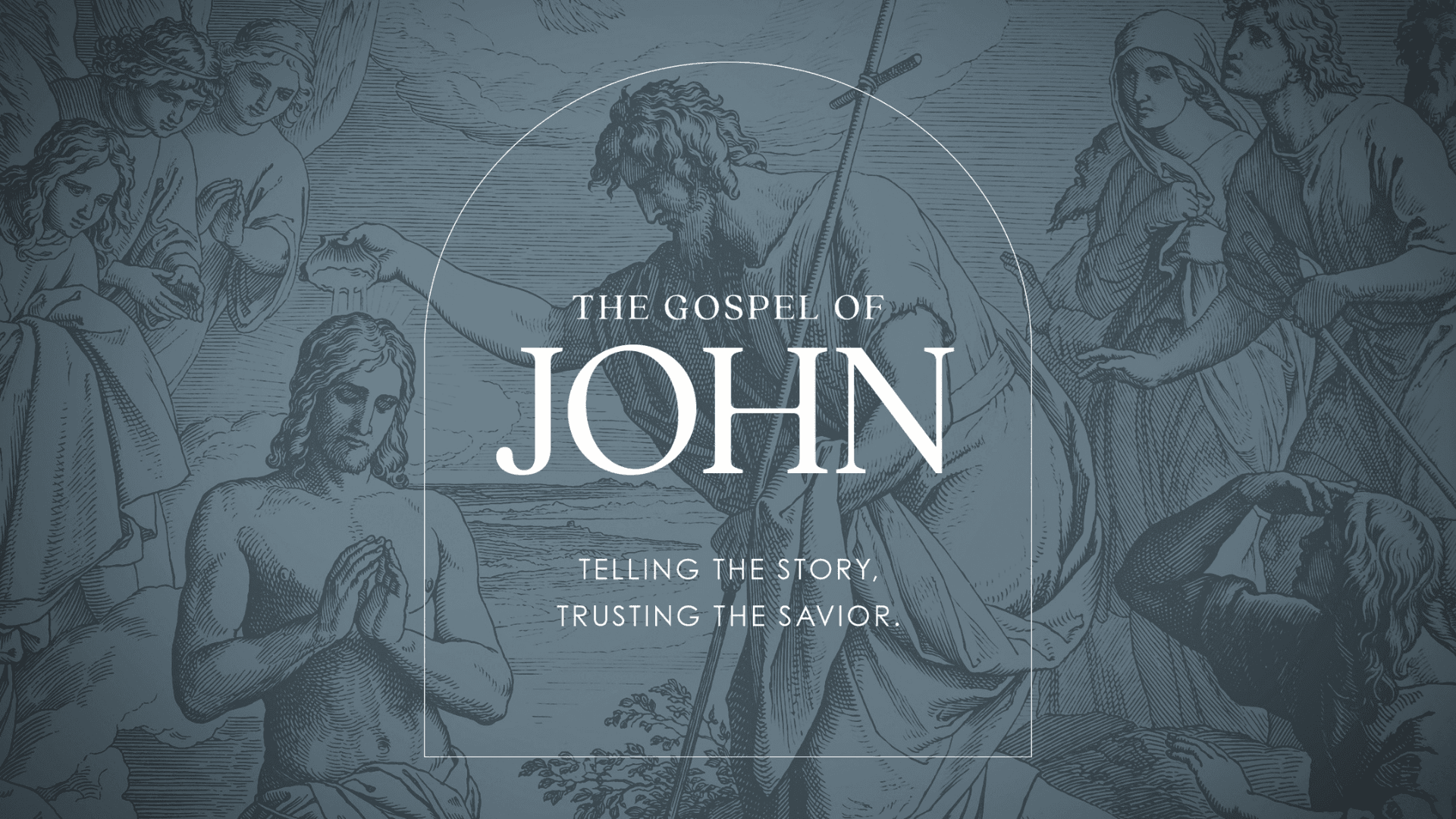
It is finally here! Join us as we dive into the first verses of The Gospel of John.
Just who is Jesus Christ? Here are some common viewpoints.
- To the Mormon, Jesus was one of many gods.
- To the Modernist, Jesus was not born of a virgin.
- To the Unitarian, Jesus was not God.
- To the Jehovah’s Witness, Jesus was a god, not the God.
- To the Universalist, Jesus will not send anyone to Hell.
- To Judaism, Jesus is seen either as an extremist false messiah, or a good but martyred Jewish rabbi. He certainly was not God.
- To the Hare Krishna, Jesus was a great avatar (teacher), but not God
- To the Jewish Kabbalah, Jesus was not God, nor was He the Jewish Messiah.
- To the Buddhist in Asia, Jesus was an avatar or a Bodhisattva, but not God.
- To Wicca, Jesus is either rejected altogether, or is merely viewed as a skilled teacher who taught love and compassion.
- To the New Ager, Jesus is the Maitreya, or the fifth reincarnation of Buddha.
- To the Muslim, Jesus was not God, but a great teacher, although still not as great as Mohammed.
There is much confusion in our world about who Jesus was when he walked the earth. It seems that the world can’t come to terms with the matter. So, who was/is He? This is, in my estimation, the question of all questions, the answer to which can and will radically change your life.
Those desirous of finding out the true identity of Jesus Christ need look no further than the words penned in 85 A.D. by one who knew Him best, the disciple named John. By this date, which was some fifty-odd years after the death and resurrection of Jesus, false concepts about the person of Jesus quietly ate away at his true identity like an army of termites.
In John’s day, especially in and around Ephesus where he ministered, a false theory was just emerging called ‘incipient Gnosticism.’ Like Christianity, it accepted the idea of salvation, a supreme deity, and heavenly beings at work in the cosmos. Unlike Christianity, Gnostics perpetuated a doctrine called dualism. For them, the world was divided into two cosmic forces diametrically opposed to each other, forces they labeled good and evil. Borrowing from Greek philosophy, they identified evil with matter, thereby forcing them to conclude that any Creator God was intrinsically wicked. Their Supreme Being wouldn’t lower himself to the level of creation. No, He was too far removed from the physical creation (which was tied to evil) to be part of its origination.
How, then, did the physical world come into being? Good question. To the Gnostic, creation was explained by a process of emanations or mediators, who proceeded from God over eons of time. These supernatural powers, which were extensions of the Supreme Being, were capable of reproducing themselves. The only problem was that the gods they produced were inferior. Somewhere along this emanation-reproductive process, a god emerged who was finally suited to create the cosmos. To them, this was the God of Christianity, Jesus. He was nothing more than a weak emanation of the Supreme Being sent to free mankind from their evil attachment to matter.
Amazing, isn’t it? This was full-blown Gnosticism, which wasn’t on the church scene until the second century, but its deadly seeds were firmly planted in John’s day. John therefore wrote to clear the air about the person of Jesus Christ and, in the process, bring people of all races and philosophical and religious positions to saving faith in Jesus.
So, as you think about the answer to the question, “Who is Jesus Christ?” realize it is an answer Satan has sought to blur and distort from the beginning, but it is one whose answer is sure if you’ll pay close attention to the inspired pen of the disciple whom Jesus loved. Here is how he answered that question in his day:
1 In the beginning was the Word, and the Word was with God, and the Word was God. 2He was in the beginning with God. 3 All things came into being by Him, and apart from Him nothing came into being that has come into being. 4 In Him was life, and the life was the light of men. 5 And the light shines in the darkness, and the darkness did not comprehend it. (John 1)
From my study and analysis of these opening words in the magnificent book of John, I see seven descriptions of Jesus Christ. And it is no wonder, because seven is the number of God, as it historically denotes perfection.
Who Is Jesus Christ?
Let us begin to open the vault of God’s mind in relation to this most important life question. Before we do this, let me make one thing perfectly clear: The “Word” in this passage is none other than Jesus Christ. Verse 14 tells us this much:
“And the Word became flesh, and dwelt among us, as we beheld His glory, glory as of the only begotten from the Father, full of grace and truth.” (John 1)
Please keep this front of mind as you consider the abstract words for Him in these opening verses.
Identity #1: Jesus Is The Eternal Word (John 1:1a)
John began his gospel like Moses began Genesis 1:1
1 In the beginning was the Word, and the Word was with God, and the Word was God. 2 He was in the beginning with God.
1 Ἐν ἀρχῇ ἦν ὁ λόγος, καὶ ὁ λόγος ἦν πρὸς τὸν θεόν, καὶ θεὸς ἦν ὁ λόγος.
1 In the beginning God created the heavens and the earth. (Gen. 1).
1 ΕΝ ΑΡΧΗ ἐποίησεν ὁ θεὸς τὸν οὐρανὸν καὶ τὴν γῆν. (The Septuagint/LXX)[1]
The rest of chapter one also demonstrates an affinity with the Genesis creation account. For example, Genesis 1 introduces the concepts of light and darkness. John picks up this motif as well (Darkness/skotos/σκότος/Gen. 1:2; light/phos/φῶς/Gen. 1:3-5; John 1:4-5, 7, 8, 9). Why did John do this? He wanted to emphasize Jesus’ eternal nature, reveal Him as the Creator (not a created being), and establish a spiritual conflict between light and darkness that Jesus would ultimately resolve on the cross.
Additionally, the phrase “in the beginning” lacks the article (as it does in the Hebrew of Genesis 1:1), “the,” in order to stress that before everything was created in the known cosmos, Jesus existed. Had John said that Jesus was “from the beginning,” people could wrongly conclude the Father created Him and then used Him as an agent of creation. That is not what the Greek reads. It emphatically underscores the truth and reality that Jesus, as deity, always existed. He had no starting point. He had no point of origin. He was not a potential being that became actualized. On the contrary, He was pure actualization with absolutely no potentiality. More on this in a moment.
Hence, Jesus, as the God-man, walked the earth from 5 B.C. to 33 A.D.[2] However, long before that, He was alive and well.
- Before the known cosmos was created, He was there. He was anterior to the beginning. He predated our space-time continuum.
- Before Mount Ararat loomed on the horizon, He existed.
- Before the Amazon cut through the forests of South America, He existed.
- Before the moon hung low on Earth’s horizon, He existed.
- Before the sun shone, He existed.
- Before the first drop of water began to fill the mighty oceans, He existed.
- Before our Milky Way galaxy hung in space with its massive diameter of 100,000 light-years, He existed.
- Before space took up space, He existed.
In the very beginning of creation, Jesus existed. John 1:1 tells us this much, as does verse 2:
“He was in the beginning with God.”
Why is this concept stated twice? Because John knew the hardness of our hearts and our propensity to do everything within our power to reject Him. His redundancy, therefore, is meant to drive this truth of Christ’s eternal nature deep into our minds so our souls can be awakened.
Note well the name John employs for Christ. He calls Him the Word. In Greek, this is translated as “Logos.” What does it mean? To the Greeks, “logos” was logic or reason. Hence, a Greek reading this text could translate it this way: “In the beginning was [the] Logic. And Logic was with God, and Logic was God.”[3]
John, who sought to reach Greeks in Ephesus for Christ, used this word, Word (Logos), wisely, because it meant so much to these Gentiles. Barclay puts this in perspective:
In 560 bc, there was an Ephesian philosopher called Heraclitus whose basic idea was that everything is in a state of flux. Everything was changing from day to day and from moment to moment. His famous illustration was that it was impossible to step twice into the same river. You step into a river; you step out; you step in again; but you do not step into the same river, for the water has flowed on and it is a different river. To Heraclitus, everything was like that, everything was in a constantly changing state of flux. But if that is the case, why is life not complete chaos? How can there be any sense in a world where there is constant flux and change?
The answer of Heraclitus was: all this change and flux was not haphazard; it was controlled and ordered, following a continuous pattern all the time; and that which controlled the pattern was the Logos, the word, the reason of God. To Heraclitus, the Logos was the principle of order under which the universe continued to exist.[4]
The Greeks were fascinated with this concept of an all-pervasive, ever-present, and powerful Logos, or Word, that governed their lives. John wisely tapped into a concept the Greeks were aware of, and he strategically equated that Logos, that Word, with none other than Jesus Christ, the One who used His spoken word as the Creator. More on that in a moment.
Back to the Greeks and their concept of the Logos, or Logic. Aristotle did not invent all the principles of logic. He merely discovered the logical principles that the Logical One, Jesus, built into the warp and woof of the cosmos (the law of noncontradiction, the law of existence, the law of identity, the law of the excluded middle, the law of causality, and the law of analogy). By logic, we surmise that something cannot possibly come from nothing. By logic, we know we can trust the math behind geometric theorems. By logic, we can surmise that complex, highly specified design could only come from a Master Designer. Yes, how can a footlong ribbon of DNA, that is “more than a billion times finer than a human hair, with three billion base pairs [that are] neatly organized, spooled, and socked inside the nucleus of a cell” be in this position without getting tangled, ever?[5] It’s hard to roll up a fifty-foot power cord without getting it all tangled. By logic, we can formulate a hypothesis, make predictions based on it, test those predictions, repeat the process, and then determine whether the hypothesis is true or false. Logic makes our world go round and make sense, and that logic originated in the One who is the epitome and essence of Logic, Jesus Christ.
To the Grecian culture, John was saying, “Jesus Christ is the eternal logical divine being who has, in turn, made His logic known to us.” Additionally, since Christ is the epitome and essence of logic, everything revealed about Him is logical. On the contrary, to deny Him is to deny logic and embrace illogic and falsity. To the Greeks, then, the opening words of John were most stirring: It was most logical to follow Jesus and to abandon the false philosophies of one’s forefathers, because He is eternal Logic and truth.
This, of course, was powerful, challenging the thinking of those people living with John in the city of Ephesus. The temple and worship of Artemis permeated this magnificent port city. With a footprint of 350 by 180 feet, it was larger than the Parthenon in Athens. Its 120 massive, ornate marble columns, each standing 60 feet tall, all pointed to the goddess’s so-called greatness. Citizens of Ephesus worshipped this goddess who had supposedly been born to Zeus and Leto on the island of Delos. She eventually became the protector of young girls, wild animals, forests, and women in childbirth. Her statue in the Artemision drew worshippers’ attention and made them fear and admire her.
Enter John. His opening statement told them that Artemis was no goddess at all, but an idol manufactured by man. She was not with the true God in the beginning, because she had a point-in-time birth. By definition, therefore, she could not be God because God, by definition, has no point of origin because He simply ontologically exists. John’s words rightly challenged the false religious system of the day, and many came to know Christ because of his bold words. Jesus, contrary to Artemis, was an effect with no cause because He was, and is, the eternal God who was with the Father at the beginning of time.
To the Jewish culture, “logos” was a powerful word in the Old Testament, denoting the creative power of God Almighty. Repeatedly in Genesis 1, we read these words: “God said … and it was so.” Psalm 33:6 puts it this way:
“By the word of the LORD the heavens were made, and by the breath of His mouth all their hosts.”
Powerful. God spoke the word, and all that is became immediately actualized. No effort. No loss of power. Jesus, who is God, spoke the words, and galaxies hung in space. With a word, canyons were cut deep into the earth’s crust. With a word, oak trees spread out their massive branches. And just who was this abstract, powerful Word? It was Jesus, the eternal God. No wonder, then, when He spoke the word, Lazarus came forth. Death had no choice but to obey His eternal power. His word is the power of all powers. This is what the Jewish mind saw in John’s opening revelation. And it was a power that was anterior to all time. Proverbs 8 told the Israelites this much. It pictures the Word as Wisdom, which played before the Father created anything:
“Before the mountains were settled, before the hills I was brought forth; while He had not yet made the earth and the fields, nor the first dust of the world. When He established the heavens, I was there, when He inscribed a circle on the face of the deep, when He made firm the skies above, when the springs of the deep became fixed, when He set for the sea its boundary, so that the water should not transgress His command, when He marked out the foundations of the earth; then I was beside Him, as a master workman; and I was daily His delight, rejoicing always before Him” (Proverbs 8:25-30).
Who is Jesus? He is the powerful eternal Word of God, the Word which is most logical to believe. Do you believe? Why haven’t you become a believer yet? What or who is holding you back from making this most logical decision?
Identity #2: Jesus Is A Trinity Member (John 1:1b, 2b)
Note that two times John says Jesus was “with God.”
1 In the beginning was the Word, and the Word was with God, and the Word was God. 2 He was in the beginning with God.
This is our first major clue that “the Word” isn’t just an abstract concept but a person, for how can an abstract concept be with someone? The clause speaks of an intimate, eternal relationship. The Word, Jesus, was with the Father God prior to the creation of the cosmos.
One can’t help but see the Trinitarian doctrine revealed here. Just as in Genesis 1 you have God creating and the Spirit hovering over the surface of the waters (Gen. 1:2), thereby indicating two members of the Godhead, here you have another member added, the Word, viz., Jesus. To the Muslim, this is an abhorrent thought, for God in their system is a simple, single Being. To the Hindu, this idea is equally repulsive because to them the Supreme Being is an undefinable, impersonal Brahman, a philosophical absolute.
But the inspired Scriptures settle the matter for all men for all time. God is One (Deut. 6:4), but He is a complex form of one, which is something you’d expect to find in a God who created the complexity we know as our cosmos. Let me ask you a logical question: Which kind of God would be more likely to have created all the complexity we see around us with the naked eye — a simple concept of God, or one so lofty and mysterious it pushes the finite mind to the limits of its ability to calculate and understand? I stand with John on the latter concept. The other views of God that make Him easy to understand are guilty of idolatry insofar as they have reduced God to manageable portions.
Read through the Scriptures, and you’ll readily see this trinitarian motif. In Genesis 1:26 Jehovah God said, “Let us create man in our image after our likeness.” Who was He talking to? In Genesis 11:7 Jehovah God said at the tower of Babel, “Let us go down.” In Isaiah 6:8, God said, “Who will go for us …” Concerning this, the late Dr. Walter Martin concluded: “These instances of plurality indicate something deeper than an impersonal relationship; they strongly suggest what the New Testament fully develops, namely, a Tri-Unity in the One God.”[6] True.
As I’ve just stated, Deuteronomy 6:4 speaks of the oneness of God:
“Hear, O Israel! The LORD is our God, the LORD is one!”
שְׁמַ֖ע יִשְׂרָאֵ֑ל יְהוָ֥ה אֱלֹהֵ֖ינוּ יְהוָ֥ה אֶחָֽד׀ ׃
However, the Hebrew word for “one” can denote what we might call complex unity. For example, in Genesis 2:24 we read: “For this cause a man shall leave his father and his mother, and shall cleave to his wife; and they shall become one flesh.” The Hebrew word for “one” here is the same as it is in Deuteronomy 6:4 (viz., אֶחָֽד, echad). No doubt, the statement from Genesis does not mean that in marriage a man and his wife automatically merge and become one person. No. They simply become a complex unity of one that now works together. The Old Testament uses the word “one” in many other instances to denote complex unity.
Some cultists will protest: “But the word trinity isn’t in the Bible; therefore, it can’t be a biblical doctrine.” Jehovah’s Witnesses make this claim. What is our response? Simple: The word Jehovah isn’t in the Bible either, which they hold inexorably as the only name for God. All we have in Hebrew are the consonants of this name: YHWH. The exact vowels are not known since the Jews would never write them, because they didn’t want anyone to say the holy name of God. Are we to conclude, then, that the word Jehovah is an unbiblical doctrine?
When we read, therefore, that the Word, Jesus, was “with God,” we should logically conclude that God is triune in structure and that the Word, Jesus, is the second member of the holy, eternal structure.
What does the word trinity mean? Geisler gives us a helpful definition:
What, then, does the word Trinity mean? It means that God is a triunity: He is a plurality within unity. God has a plurality of persons and a unity of essence; God is three persons in one nature. There is only one “What” (essence) in God, but there are three “Whos” (persons) in that one What. God has three “I’s” in His one “It”—there are three Subjects in one Object.[7]
This is who the Word is. He is the second member of the Holy Trinity. How do you best illustrate this grand, complex mystery? Geisler is, once more, insightful:
No illustration of the Trinity is perfect, but some are more helpful than others. Those that are better involve things where three different elements exist in an undivided oneness at the same time.
A Triangle
God is like a triangle, which is one figure yet has three different sides at the same time—there is a simultaneous threeness in the oneness. Of course, no analogy is perfect, since in every analogy there is a similarity and a difference. The difference here is that “corners” are not persons. Nonetheless, they do illustrate how there can be a “threeness” and a oneness at the same time.
One to the Third Power
Another helpful illustration is that God is like one to the third power (1×1×1=1). God is three ones in One; He is not 1+1+1=3. That is the heresy of tritheism, which holds three different gods, not just one God.[8]
Here is one more way to think about the Trinity…
Suppose you lived in a one-dimensional world. Next, suppose a three-dimensional person inserted three fingers into your world. You would only see the points where their fingers actually intersected with your world. You would not see all of their three-dimensional fingers, nor would you see that their fingers are actually part of one hand. Your problem, in this scenario, is all about dimensional limitations. So, it is when we attempt to describe God, who dwells in a dimension far beyond how ours is constructed. He is one, but in a way our dimension cannot adequately comprehend. To attempt to describe Him based on the laws of our dimensional construction would be a category mistake, because His dimension is not ours.
Even these excellent analogies break down in the face of the Holy Trinity’s complexity. But, as a logical thinking person, you should expect this because you are seeking to understand God, who is infinite, with a very limited, finite mind.
Thus, when I read last summer about the jaw-dropping complexity of the human eye, I couldn’t help but think of Jesus, who is the second member of the highly complex Trinity. Jay Sonstroem, a scientist who worships with us, talks about this in his book Loving Science-But Not The Empire:
The Optics: . . . If evaluated independently, the cornea and the lens each introduces significant optical aberrations, but together they compensate for each other, and produce an outstanding image . . . The cornea has a fixed focus, and the lens has a variable focus. The lens is surrounded by a circular ring of muscular tissues, which are attached to the lens by microscopic ligaments, providing an objective optical system. The eye has an autofocus which is called accommodation, and operates via the pliable lens, the focal length of which is under neural control. Unlike the autofocus and a camera, which is controlled by one source of information, diet makes use of a host of sources, depending on the visual scene . . . Taken for granted, but observe beyond recognition, is the fact that the cornea, the lens, and everything else in the optical path of the eye is transparent. The eye is actually covered by a layer of skin, but here the skin is transparent. The cornea is made of finely packed collagen fibers, again constructed to be transparent. Of course, the lens is also transparent, made of transparent proteins called crystallins. Both the cornea and the lens are avascular, meaning they have no direct connection to blood vessels. But they need oxygen and nutrients, so how do they get these? The front of the eye contains two chambers bathed in a crystal-clear fluid called aqueous humour. This fluid is rich in the needed oxygen and nutrients, which are supplied through the process of diffusion, and the fluid itself is exchanged about every 90 minutes. The rest of the eyeball has a separate chamber filled with vitreous humour, clear jellylike substance. Every transparent component has the right refractive index to deliver a near perfect and focused imaging system.[9]
And you want me to believe this all assembled itself over millions of years? I don’t think I am falling for that illogical reasoning. Complexity like this, which is hard to understand as a layperson, points not only to Jesus as the eternal God who was with the Father when this complexity was made. It also prompts our small human minds to consider that this complexity had to be created by a divine being who dwells in a greater complexity. That divine being exists, as John begins to demonstrate in this opening chapter, and has a highly complex and unified relationship: one essence (divinity), yet three persons united in that essence. Of these three, Jesus Christ is the second member of the Holy Trinity who came to earth to do battle with sin and darkness so that we, as sinners, would have the opportunity to become saints in His magnificent and otherworldly family.
Do you know Him? Now that you know who Jesus was and is, I think it is time to move from unbelief to belief. When you do, you will have no problem singing verse three of the old hymn How Great Thou Art:
And when I think that God, his son not sparing, sent him to die, I can scarce can take it in: that on the cross, my burden gladly bearing, he bled and died to take away my sin.
Then sings my soul, my Savior God, to the: how great thou art! How great thou art! Then sings my soul, my Savior God, to the: how great thou art! How great thou art!
Carl Boberg, 1885
Stuart K. Hine, 1949 English translation and new verses
[1] Henry Barclay Swete, The Old Testament in Greek: According to the Septuagint (Cambridge, UK: Cambridge University Press, 1909), Ge 1.
[2] Harold Hoehner, Chronological Aspects of the Life of Christ (Grand Rapids: Zondervan, 1977), 143.
[3] Norman Geisler, Ronald Brooks, and Gordon H. Clark, Come Let Us Reason (Grand Rapids: Baker Academic, 1990), 1.
[4] William Barclay, The Gospel of John, Rev. and updated., vol. 1, The New Daily Study Bible (Edinburgh: Saint Andrew Press, 2001), 40–41.
[5] Jay Sonstroem, Loving Science—But Not The Empire (Bloomington, IN: WestBow Press, 2023), 20.
[6] Walter Martin, The Kingdom of the Cults (Minneapolis: Bethany Fellowship, INC., Publishers, 1972), 54.
[7] Norman L. Geisler, Systematic Theology, Volume Two: God, Creation (Minneapolis, MN: Bethany House Publishers, 2003), 279.
[8] Norman L. Geisler, Systematic Theology, Volume Two: God, Creation (Minneapolis, MN: Bethany House Publishers, 2003), 294.
[9] Jay Sonstroem, Loving Science-But Not The Empire (Grand Rapdis: Westbow Press, 2023), 53-54.