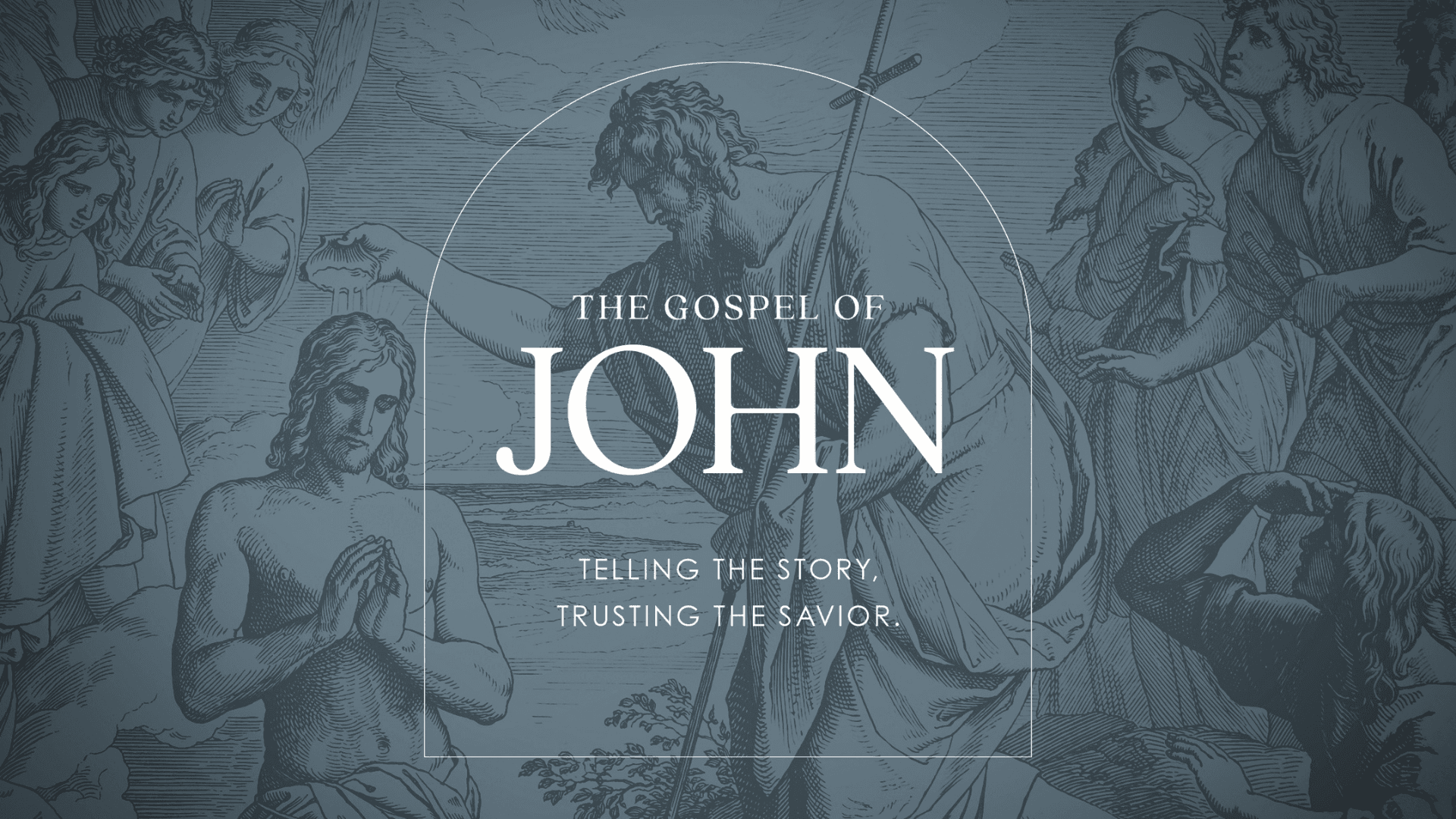
In John 1:19-34, we see John the Baptist faithfully point others to Jesus, declaring Him to be the Lamb of God who takes away the sin of the world. As John makes it clear that he is not the Messiah, he directs attention to the One who came to bring salvation. Through this passage, we’ll explore the identity of Jesus, the significance of His mission, and what it means to faithfully point others to Him.
Scripture gives us many apt descriptions of those who don’t know Christ as Savior. Saint Jude’s is representative of countless verses we could look at in this vein. Jude’s viewpoint: Non-Christians are like … “13 wild waves of the sea, casting up their own shame like foam; wandering stars, for whom the black darkness has been reserved forever.” Just like waves appear to be wildly out of control as they crash against the beach, so the non-Christian is known for their wild ways, their proclivity for living contrary to God’s laws. Seen any “wildness” lately? A brief perusal of the news from Thursday of this week tells the story:
- Nine Florida high school students ganged up and beat one student who stopped them from bullying a girl. They are now facing charges.
- A young woman stalked a Jewish man in NYC and then stabbed him with a syringe.
- Communist and Islamic radicals rioted in France. They looted Jewish businesses, burned down historic buildings, and beat people senseless. Insane.
- Seems like medical fraud is everywhere. 15 defendants, including medical personnel, were charged with $1.6 billion in sham rehab charges. Shocking.
- More and more boys who don’t excel in sports against girls are joining female high school teams as girls. Brave girls like Elise Bierer of Camas High School walk off the starting line when the gun sounds because they know they can’t beat a male.
- Many Americans shamelessly attack Federal agents all in the name of stopping fascism, hate, and intolerance. Aren’t they the fascists who are guilty of hate, intolerance, and a disrespect for law and order?
- Two WNBA teams walked off the court before the national anthem during the 2026 WNBA finals. What? Is our country so terrible you can’t bear to hear the national anthem anymore? Where’s the respect for all those brave men and women who died for that flag to make sure our country is free?
- A man running for Texas State Representative recently said that “God is non-binary.” Some nodded their head in agreement. Has he not read the inspired Word of God that uses masculine terms to describe God?
Wildness defines our culture. Disrespect is in. Respect is out. Malleable laws are in. Absolute laws are out. Meanness is in. Niceness is out. Lawlessness is in. Lawfulness is out. Intolerance is in. True tolerance is out. Hostility toward Christianity is in. Respect for Christianity is out. Perversion is in. Modesty is out. I could go on, but you get the point. The power of wild, sinful waves is pounding the shoreline of our nation at every level, from the seat of government to how fans react to each other during a football game.
All this disintegration begs a question: How should the Christian, delivered from this wildness by faith in the cross of Christ, best seek to reach those still caught in the powerful current? Answer? Learn from the life of John the Baptist, who was highly successful in rescuing folks from the perpetual cycle of sin and shame. Just what did he do? We will focus on that today.
How Should You Attempt To Rescue The Non-Christian From The Strong Current of Chaos? (John 1:19-34)
First, let us read the context; then we will be better positioned to extract the concepts we need. A cursory reading shows John took a three-fold approach in his quest to save people from the endless, chaotic crash of the waves of sin.
Entertain Their Questions (John 1:19-25)
People are by nature inquisitive. They’ll want to know answers to questions like, “Why don’t women’s blouses come in sleeve lengths, like men’s shirts?” “Why do we park on driveways and drive on parkways?” “Why do 7-11 stores, which are open 24 hours a day, have locks on their doors?” “Why is there no channel 1 on televisions?” “Why does water drain out of a bathtub in a counterclockwise direction north of the equator and clockwise south of the equator?” Yes. People like to ask questions. Understand this, and realize it logically drifts into matters religious.
From verse 19 we learn that the Jewish authorities in Jerusalem, probably the Sanhedrin, sent a priestly delegation to find out just who John the Baptist thought he was.
In attempting to clear the air where John was concerned, they asked him six questions:
- Question 1: Who are you (v. 19)?
- Question 2: Are you Elijah (v. 21)?
- Question 3: Are you the Prophet (v. 21)?
- Question 4: Who are you (v. 22)?
- Question 5: What do you say about yourself (v. 22)?
- Question 6: Why are you baptizing (vv. 24-25)?
What are your questions? I’m sure you have some. Here is a sampling of common ones:
- If God is good, why is there evil?
- Why should I abandon the facts of science for the emotionalism of faith?
- If there is a God, why did He make it so hard to know He exists?
You know, if you are going to pose questions to a well-educated, well-versed, and seasoned saint, you should probably get prepared to have your worldview challenged. The fact that they asked him six questions is a veiled statement about their opposition to his message. How so? Is not six the number of man, and the number of the ultimate anti-god man, the Anti-Christ? The answer is “Yes.” The number six tells you they had no intention of knowing truth. They were men in the sense that man is arrayed against everything God stands for. The mere first usage of the phrase “the Jews” in verse 19 underscores this point because this term will come to denote the Israelite nation opposed to Christ and Christ’s messengers. Regarding their questions, permit me to make these brief comments.
Question #1 (John 1:19).These men knew John was from the priestly tribe of Levi, as his father, Zacharias, was. Given the huge crowds he was attracting, what they really wanted to know was who gave him authority to preach and baptize as he did. Hence they asked John, “Who are you” (John 1:19). Who did he think he was since he obviously wasn’t under their authority? Place heavy emphasis here upon the word “you,” and you’ll get a flavor of their animosity toward John. Their reaction is the same reaction you get today from people when you make a stand for Christianity: Who do you think you are, believing Christ is the only way to heaven? Who are you to say I’m a sinner? Who are you to be so intolerant of other belief systems? When they really wanted to know whether John was the Messiah or not, he definitively replied “I am not the Christ” (v. 20).
Question #2 (John 1:21). Based on Malachi’s prophecy (Mal. 4:5), Elijah was supposed to return to earth before the Messiah’s appearance. Because John dressed like Elijah (camel hair and leather girdle, Mark 1:6; 2 Kings 1:8), they needed to clear the air for themselves. Again, the emphasis here is upon the word “You.” “Are you Elijah? Give us a break. We know your father. He is a Levite in the temple.” Levites belonged to the tribe of Levi, but were not direct descendants from Aaron, therefore, they couldn’t be priests, just helpers of the priests. John’s reply was direct, “I am not [Elijah].” The Synoptic gospels connect John with Elijah, the end-time prophet (Matt. 11;14; 17:12; Mark 9:13; Luke 1:7); however, John never made this equation with himself. So, he denied it (John 1:20).
Question #3 (John 1:21). Moses prophesied in Deuteronomy 18:15-19 that at the end of the age the prophet of all prophets would come to earth. Indeed, this man would be the second Moses. Did John actually think he was that prophet? Again, I believe there is an undercurrent of sarcasm in their questions: “You, John, think you’re THE prophet? Really. Are you joking?” John’s reply, again, is short and sweet: “No.”
Question #4 and #5 (John 1:22-23). Here they really repeat what they’ve asked before out of utter frustration. “Who are you that we may give an answer to those who sent us? What do you say about yourself?” (John 1:22). He replied that he is the prophesied voice from Isaiah 40:3, foretold to call people to God before the Messiah’s entrance into world history.
Question #6. This one tips their hand (John 1:24-26). They strongly opposed John’s baptism. This is what ate away at their theological thinking and training. Jews baptized Gentile converts to Judaism by dunking them under the water, but they didn’t do this to Jews. Jews often used miqva’ot (plural, or mikveh, singular), pools of standing water, to baptize themselves for ceremonial cleansing. John went way beyond this. He did the baptizing, and it was of Jews, no less. To baptize a Jew was, in the strict theological system of the Pharisees, a heretical, abominable action because Jews already were part of God’s family and nation. “How dare John baptize a Jew. Who did he think he was?” This was what they were really saying. They questioned his actions and authority, and it took six questions before we obtained a good look at the motives behind their religious questions.
Why was John baptizing Jews? Because he knew they needed salvation, just like the Gentiles. They needed spiritual cleansing just like Gentiles. Their heredity wasn’t going to save them from their sinful, wild, wayward ways. Only a faith relationship with God would do that.
From these questions posed to John, we learn an important lesson. Be prepared to handle the questions the world will pose to you. Some may be honestly searching for spiritual answers, while others might hate you for your belief in Christ. Answer anyway. John did. He didn’t let the questions undo him. He expected them. You and I should do the same.
Let me put it to you this way. If non-Christians aren’t asking you spiritual questions, then you need to do a little soul-searching, wouldn’t you agree?
Look at the lives of godly saints in the Scriptures, whether it is John the Baptist or Paul, and one thread is always present: The godless world asked questions of those who didn’t follow their flow. The non-Christians in our world are no different. They will want to know if you are accepting of Islam, whether you believe in Near Death Experiences, what you think about UFOs, what you think about sex and gender, whether God exists or not, if we are living in the End Times, whether Christians should support Israel or not, and so on. Bear in mind the questions may be logical or illogical, loaded or unloaded, nice or nasty, but they will come if you rub shoulders with non-Christians. You should always be ready to speak up for Christ. Peter’s counsel in this regard is spot on:
15 But sanctify Christ as Lord in your hearts, always being ready to make a defense to everyone who asks you to give an account for the hope that is in you, yet with gentleness and reverence. (1 Pet. 3)
Are you prepared to answer? How do you get prepared? Read the Word of God constantly. It is your spiritual milk (1 Cor. 3:1-3), meat (Heb. 5:11-14), lamp (Psalm 119:105), sword (Eph. 6:17; Heb. 4:12), hammer (Jer. 23:29), and a mirror (James 1:23-25). Read systematic theologies. Most questions I’m asked are answered in books like these. So, read them. They are typically divided into various categories: The doctrine of God, Jesus, the Holy Spirit, Salvation, End-times, and so forth. What are good systematic theologies? Here are a few to consider:
- Charles Ryrie, Basic Theology
- Norman Geisler, Systematic Theology, 4 volumes
- Wayne Grudem, Bible Doctrine
Make it a life goal to always be reading these types of books so you are prepared to field questions from non-Christians.
Additionally, read apologetic books that actually answer the most common questions non-Christians ask. Norman Geisler, my mentor, has several books along these lines:
- Bringing Your Faith to Work. Here is a sampling of some of the questions Geisler poses and answers:
- Are All Religions True?
- Does God Exist?
- Did Humans Evolve?
- Are Miracles Possible?
- Can We Trust the Bible?
- Are There Errors in the Bible?
- When Skeptics Ask: A Handbook on Christian Evidences. Here are some of the questions he poses and answers:
- Questions About God
- Questions About Evil
- Questions About Bible Difficulties
- Questions About Truth
- Questions About Morals
Another helpful book is The God Conversation by J.P. Moreland and Tim Muehlhoff. The authors demonstrate how to answer the typical questions non-Christians pose by using excellent stories and illustrations. It’s a short read at only 151 pages. Another great book to add to your apologetic repertoire is The Popular Encyclopedia of Apologetics by Ed Hindson and Ergun Caner. In a few seconds, you can look up a question you are being asked and find a viable answer. A meatier version of this book is Geisler’s The Big Book of Christian Apologetics. I read this for one of my doctoral classes and found it quite enlightening and useful. So, set a goal today to hone your skills in fielding questions from the non-Christians around you. Why should you get prepared? Eternity is at stake.
Also, understand there are times when you don’t have to field questions. Of all the questions John received this day, he didn’t answer the sixth one. He left them to chew on that one. It wasn’t worth his time, so he moved right past it, and in this he shows us that if and when you’re talking to a person bent solely on discrediting you and your Lord, it is enough to remain silent, or at least change the subject.
But for the most part, answer! Speak up! Speak out! Do this with a loving, kind, and patient spirit. Darrell Bock, the senior research professor at Dallas Theological Seminary, echoes this statement in his book Cultural Intelligence: Living For God in a Diverse, Pluralistic World:
We are called to be an incarnation of God’s presence in the world, his audiovisual in a unique set of individuals and a special community. How we engage in showing God’s grace and character matters. The content of what we believe matters, but so does our tone.[1]
Later in this opening chapter, Dr. Bock gives us this wise word of counsel when we engage non-Christians:
Our assignment is to draw on those resources (i.e., spiritual resources God has put at our disposal like the Word, great apologetic books, and so forth) rather than rely on those that make us more like the world. We do so by engaging intelligently with people who think differently than we do. Not by despising or disrespecting them, but by seeing them as hostages in need of rescue. When we act like the world and perceive them as enemies, our rescue mission goes off course and we lose our spiritual advantage.[2]
How true. Non-Christians are not the enemy; they are the goal of Christ’s gospel.
Os Guinness gave me a copy of his book Fool’s Talk when he published it in 2015. In it, he argues that Christians need to return to the fine art of loving persuasion as we engage an ever more hostile world. Winning arguments is, therefore, not the goal. It is winning hearts and minds for Christ through our loving demeanor wedded to our God-given answers to non-Christian questions:
When the message of Jesus comes to the foreground, method must be left in the background, where it belongs. It is said rightly that love is “the final apologetic,” in the sense that our best argument is our love for the people we talk to. That is not the end of the insistence on love. Love is “the alpha and the omega of apologetics,” in the sense that all we say must come from love, and must lead to love and to the one who is love– in other words, Christian advocacy must move from our love for God and his truth and beauty, to our love for the people we talk to and work right up to their love for God and his truth and beauty in their turn.[3]
Hence, how you speak is just as important as what you speak, maybe even more so. Therefore, pray for the Lord to give you His demeanor as you engage the wide array of non-Christians He will bring across your life path.
Express Your Role (John 1:23)
When they pushed John to reveal who he thought he was, he said:
“I am a voice of one crying in the wilderness, ‘make straight the way of the Lord.”
Quoting here from Isaiah 40:3, John says in a Marty paraphrase, “Say, look, men. All I am is God’s mouthpiece to you. All I am doing is telling you what He tells me. All I am doing is clearing the road of debris so He can come and present Himself to you. I am only a messenger boy, an ambassador, nothing more, nothing less.”
Eastern roads were nothing like our roads. They were just well-worn ruts in the hard, rock-strewn dirt. When a king or dignitary was going to visit a certain area at this day and time, people would go out and smooth out the roads, removing anything which might make His visit difficult, unpleasant, or impossible. Instead of this, John is saying, “Hey, I’m just doing what you do when a king comes to visit. You clear the road. I happen to be clearing away false theology and false thinking so He can arrive.”
Is this not who we should be to the wild waves that come our way? Are we not just voices seeking to clear away the obstacles in their lives so the King can come to them? Are we not voices seeking to get them to straighten out their lives so Jesus can be their Savior? The answer is “yes” on all counts.
- To the person living in sexual sin, you are a voice.
- To the person who has bought into an illogical, vacuous philosophy, you are a voice.
- To the person who thinks the roles of men and women are interchangeable, you are a voice.
- To the person who actually believes man is intrinsically good, you are a voice.
- To the person who thinks freedom of speech means total speech freedom to say anything you want, you are a voice.
- To the person who thinks euthanasia is a viable option at the end of your life, you are a voice.
- To the person who wants you to believe that Christianity and Islam can live side by side peaceably, you are a voice.
In the final analysis, if we are Christians, like John, then we are nothing more than the voices of God to a wicked, decadent, dying culture. We are just as much God’s voice to our day as John was to His. You are really just one beggar pointing another beggar to the Bread of Life, Jesus Christ. Do you realize this? Should you choose to be the voice, your life, like John’s, will become a major catalyst for change wherever God places you.
You’ve got to ask, “Why was John out in the wilderness?” “Why did he call God’s chosen, yet wayward, people to head out into the middle of nowhere and repent and be baptized?” Because the wilderness aptly described the nation’s spiritual condition. They were dry, barren, and lifeless, and in need of God. Once they arrived in the wilderness, they heard John’s voice, which led them to life and light. Tell me today, Christian, will you be the voice to this generation of questioners? They, too, live in a desert, but you can give them the garden. Do what you’re designed to do.
Have you ever used a compass? It doesn’t matter which direction you turn it; it will always point to magnetic north. Always. Nothing will keep it from doing what it’s designed to do. It never gets off course. It never gets led astray. It never forgets what it’s supposed to do. It is never too busy to do its job. All it does is point to the north.
Is this not an apt description of each of us as Christian’s? We, likewise, must be known as God’s voice when the opportunity presents itself. This is who we are, this is what we do, and when this happens, the wild waves meet someone who can point them to the value of knowing Christ by faith.
Exude Humility (John 1:23, 27, 30)
John was the greatest man who ever lived, outside of Christ, of course, because his life dripped with humility. You see it in verse 23 when he said,
“I am a voice …”
He could have said, “I am a mighty prophet of God worth listening to,” or “I am John the Baptist, the wild-eyed, booming prophet that thousands are coming to listen to.” Yes, he could have said these things, but he didn’t. He didn’t want anything about his life to detract from the view of Jesus.
In verse 27 you bump into his utter humility again when he said of Jesus,
“It is He who comes after me, the thong of whose sandal I am not worthy to untie.”
And, you see it repeated once more in verse 30:
“This is He on behalf of whom I said, ‘After me comes a Man who has higher rank than I, for He existed before me.”
What humility!
Verse 27 is most instructive. The religious leaders were curious about who gave him the power to baptize if he wasn’t the Messiah, Elijah, or the prophet (John 1:24-25).
24 Now they had been sent from the Pharisees. 25 They asked him, and said to him, “Why then are you baptizing, if you are not the Christ, nor Elijah, nor the Prophet?” (John 1).
They worried about where he thought his spiritual authority to baptize came from. He didn’t answer this question.
26 John answered them saying, “I baptize in water, but among you stands One whom you do not know. 27 It is He who comes after me, the thong of whose sandal I am not worthy to untie.”
He simply said he was a humble, godly man who baptized to prepare people for the Messiah the religious leaders didn’t yet know. He went further, saying he wasn’t even worthy to undo the sandal of this coming One.
Talk about a menial, degrading job. Only slaves untied the shoes of very important people. John says, in effect, “I’m lower than the lowest slave, thereby making me unable to even think of touching the leather strap of the Messiah’s sandal.” What humility from a man who could have been quite self-consumed with his own fame. Lesser men would have seized the opportunity to touch Christ’s sandals so they could use it as a point of prestige later. “Why, this very hand here had the privilege on one occasion of actually touching the sandals of God’s Son. Would you like to shake this hand?” A humble man, by contrast, realized that godly life is a fight not for the top but the bottom, that the background is better than the foreground, and that dim light is better than the limelight.
Had John lived our day, with our emphasis on self-aggrandizement and self-intoxication, and our penchant for taking selfies and quickly loading them on Instagram, he would have been tempted to parlay his spiritual position and personal relationship to great advantage.
- “Think of the money I can make on eBay selling my sandals and camel hair coat. Stuff like this will rake in the money.”
- “I think I will have a satellite broadcast in all the synagogues of Israel where I can share my secrets of the ascetic life. Since I was so successful, I know everyone will want to copy what I’ve done. ”
- “I’ll get a publisher to get my latest biography, “I Baptized the Messiah,” into print and on the top ten best sellers in Jerusalem.”
- “I’ll make a book of my special wilderness recipes designed to get you closer to God. Surely people will love chapter one, “Cooking With Crickets,” or how about chapter 2, “Basting With Beetles.”
- “Because I’m related to and close to the Messiah, I can charge a hefty speaking fee.”
Isn’t this how we are in the West? Just let a Christian find the right church growth concept or come across helpful marriage-building concepts, and “presto-chang-o,” you have a market born to push your spiritual goods while bringing a great deal of notoriety to your once-unknown name.
A young American student visiting the Beethoven Museum in Bonn was fascinated by the piano on which Beethoven had composed some of his greatest works. She asked the museum guard if she could play a few bars, and he agreed. The girl sat down at the piano and tinkled out the opening of the Moonlight Sonata.
As she was leaving, she said to the guard, “I suppose all the great pianists who come here want to play on that piano.” The guard shook his head: “Well, Paderewski was here a few years ago, and he said he wasn’t worthy to touch it.”
Isn’t the young woman a picture of most people? She thought highly of herself, didn’t she? Isn’t Paderewski, the famous pianist in his own right, a perfect snapshot of John the Baptist? Let me be frank with you today, Christian: humility is what makes the witness.
John was made of finer stuff. He was a humble man who didn’t want anything in his life to detract from a clear view of Jesus. Perhaps you haven’t been more effective in your Christian walk simply because the non-Christians around you can’t see Jesus. After all, you’re too busy directing them to look at you, your faith, your church, your last Bible study, your model family, your connections, your rank, your education, and your, … well, you fill in the blank.
Humility is the key that opens the door to successful witnessing. Here’s a prayer for today: Lord, forgive me for my arrogance, for promoting myself instead of showcasing you. Show me how I can live a more humble, selfless life.”
[1] Darrell Bock, Cultural Intelligence: Living For God in a Diverse, Pluralistic World (Nashville: B & H Academic, 2020), 6-7.
[2] Bock, Cultural Intelligence, p. 16.
[3] Os Guinness. Fool’s Talk (Downers Grove: IVP Books, 2015), 45. I