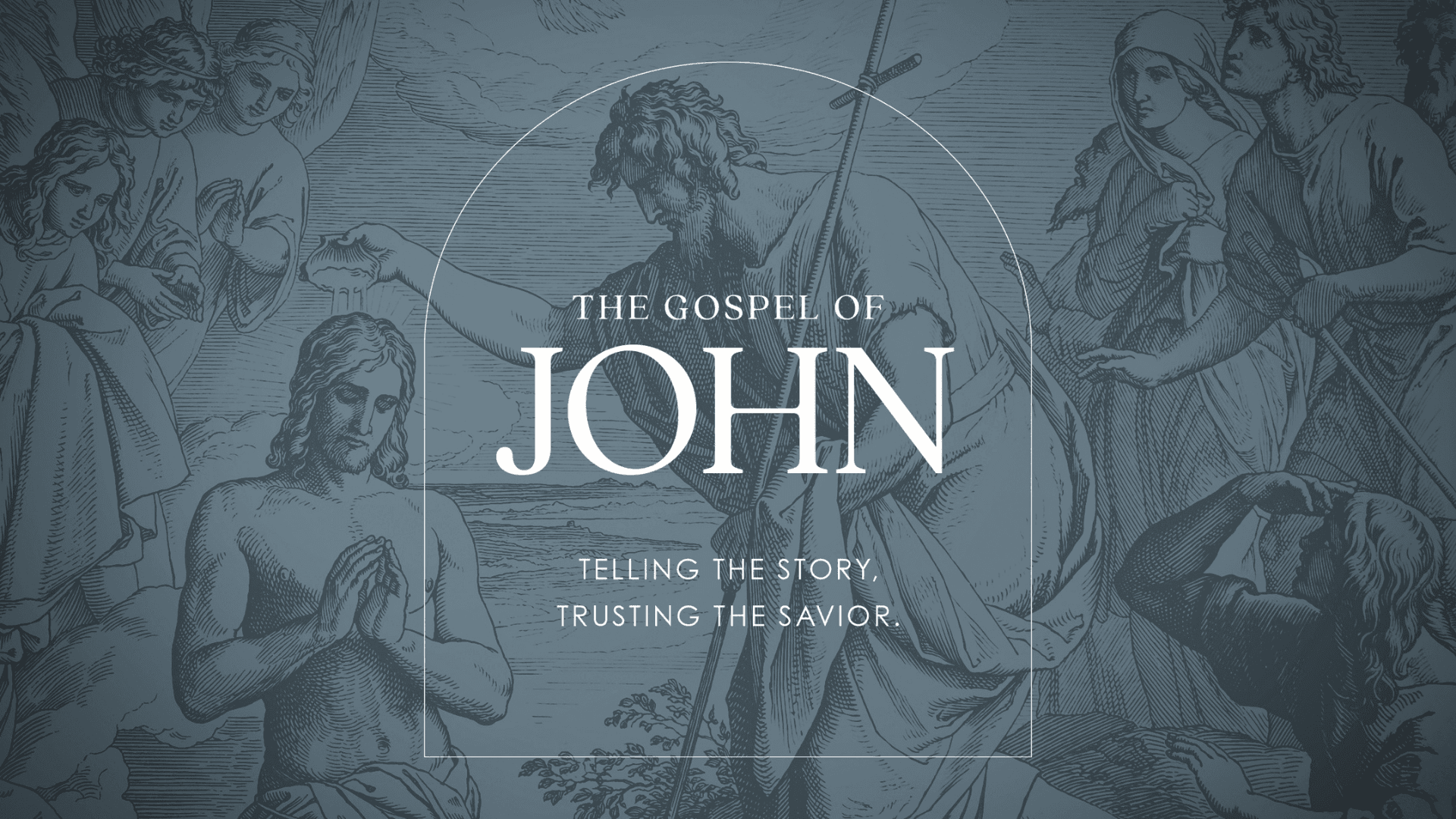
Have you encountered the light of Jesus? Does His light shine through you? Join Dr. Marty Baker as we continue in our series in The Gospel of John and take a look at the life and ministry of John the Baptist.
Who is Jesus Christ? As we have seen from the inspired pen of John in John 1:1-5, He is none other than the perfect God-man. He is the eternal God. He is the God of creation, of Adam and Eve, of Noah, of Samson, of David, of Daniel, who took upon a body of flesh and bone and became one of us so He could become our Sacrifice and Savior. For those wondering back in 95 A.D. who Jesus was, ol’ John left them no room for doubt in the opening words of his monumental work.
For those of us who believe John’s words about Jesus, we must understand that God wants our faith to put on overalls and get to work. He doesn’t want us to sit in the ivory towers of intellectualism, reflecting on all the wonderful truths about the person of Jesus. No. He wants us to act based upon what we know, to do our part to turn the godless world back to Him.
As we learn in John 1:6-18, John the Baptist is a perfect example of what a Christian today should do with the knowledge of Christ’s person and work. Was he an obscure man, content with living in isolated desert hideaways? Indeed. Did he have a weird diet, consisting of bizarre food like locusts? I guess he liked the crunch factor. Did he dress a little eccentrically? Was somewhat of an introverted isolationist. Yes.
But in Jesus’ eyes, John was one of the greatest men who ever lived. As Jesus said in Matthew 11:11:
“Truly, I say to you, among those born of women there has not arisen anyone greater than John the Baptist; yet he who is least in the kingdom of heaven is greater than he.”
Why was John highly esteemed in the eyes of Christ? Because he lived each day to the fullest in light of what he realized about Jesus. Once he recognized Jesus’ deity, he was never the same. In fact, he became passionately consumed with making sure the rest of the world knew what he knew.
Let John, therefore, be a working model for each of us who call Jesus Lord today. He is not placed at the opening of the book of John without reason. We bump into him at the opening, so we’re challenged to live as he did, in light of his knowledge of the Christ. How did John live? How should I live? Christ’s deity drove John, and should drive us, to learn two main life points.
How Should The Saint Live In Light Of Christ’s Deity? (John 1:6-18)
Know Your Call (John 1:6-9)
Every saint has God’s call on their life. Do you remember the prophet Jeremiah? One day the Lord made him aware of his life mission with these memorable words:
“Before I formed you in the womb I knew you, and before you were born I consecrated you; I have appointed you a prophet to the nations”(Jer. 1:5).
Note first when God called Jeremiah: in the womb. This is why we wholeheartedly support unborn life. This is why we vehemently oppose our State’s devilish pursuit to change our Constitution to permit abortion up to the time of birth. The living God forms all those unborn children in the womb, and He has a divine call on their lives. To tamper with this is to attack and destroy the very work of God.
Further, God called Jeremiah to be His voice to the godless nation, Israel. His job description couldn’t have been clearer: show Israel the way out of sin and the path back to God until he drew his last breath. He might have been preoccupied with other things in his life, but in his heart and mind he always knew what he was on earth for. There was no question about that. The fire of God’s mission burned continually in his heart, and it had to come out. John was like Jeremiah in that he knew God’s call was upon his life.
What was that call? As we see from these verses, it was twofold. It applied to John, and it also applies to us; therefore, we will make our supporting points personal.
You Are A Pointer…
Verse six tells us this much:
6 There came a man sent from God, whose name was John (John 1)
It is interesting how John is called in verse 6, “a man, sent from God.” The word for “sent” is most instructive. The verb is a perfect, passive participle. The perfect tense shows a past act with an abiding result. The implication is clear: When God sends you, it is a calling until you pass into His glorious presence. The verb’s passive nature tells us you don’t call yourself to this divine duty. No. God reaches down from heaven and calls you to be on a mission for Him. The following verses describe and unveil the nature of that mission.
Additionally, the Greek for “sent” comes from the word “apostello,” a combination of two Greek words: “apo=from” and “stello=to send,” hence, to send out (John 1:6 Ἐγένετο ἄνθρωπος, ἀπεσταλμένος παρὰ θεοῦ, ὄνομα αὐτῷ Ἰωάννης.) In ancient times, this word referred to emissaries sent by a dignitary with a personal message. New Testament writers adopted this word for saints because it best described their spiritual duty. They were sent out with a message from the ultimate dignitary, God.
Study the New Testament, and you’ll see this truth. The disciples were “sent out” (Matt. 10:5, Τούτους τοὺς δώδεκα ἀπέστειλεν ὁ Ἰησοῦς παραγγείλας αὐτοῖς λέγων, Εἰς ὁδὸν ἐθνῶν μὴ ἀπέλθητε καὶ εἰς πόλιν Σαμαριτῶν μὴ εἰσέλθητε, Mk. 3:14); prophets were “sent out” (Isa. 6:8, 8 καὶ ἤκουσα τῆς φωνῆς Κυρίου λέγοντος Τίνα ἀποστείλω, καὶ τίς πορεύσεται πρὸς τὸν λαὸν τοῦτον; καὶ εἶπα[1] Jer. 7:25), angels were, and are, “sent out” (Dan. 4:13, 23; Heb. 1:14, οὐχὶ πάντες εἰσὶν λειτουργικὰ πνεύματα εἰς διακονίαν ἀποστελλόμενα διὰ τοὺς μέλλοντας κληρονομεῖν σωτηρίαν), and even Jesus was “sent out” by the Father (Matt. 15:24; Mk. 9:37; John 3:17, οὐ γὰρ ἀπέστειλεν ὁ θεὸς τὸν υἱὸν εἰς τὸν κόσμον ἵνα κρίνῃ τὸν κόσμον, ἀλλʼ ἵνα σωθῇ ὁ κόσμος διʼ αὐτοῦ).
The implication is clear: God has “sent out” you as well (The Great Commission of Matthew 28:19-20 is a case in point). Every Christian sitting here today is on a divine mission. God didn’t redeem you with the costly, rich, red, and royal blood of His Son so you could sit and soak up sermons, Bible studies, and worship. He redeemed you so you would be sent. Have you awakened to this reality yet?
The question is, “What is the goal of a ‘sent one ‘?” Look to John for your answer.
7 He came for a witness, that he might bear witness of the light, that all might believe through him. 8 He was not the light, but came that he might bear witness of the light.9 There was the true light which, coming into the world, enlightens every man” (John 1:7-9).
Take a pen and underline the word “witness” here. You’ll find it two times in verse 7 and once in verse 8. The Greek word will sound familiar: marturia (μαρτυρία). Greeks used this term in court to describe someone who relays the truth of what they know about a particular situation or person. Quite naturally, it evolved to apply to anyone who gave testimony that invited death.
μαρτυρία, ας, ἡ (s. μαρτυρέω; Hom.+—KLatte, Martyria: Pauly-W. XIV 2, 2032–39; Kl. Pauly III 1058). ① confirmation or attestation on the basis of personal knowledge or belief, testimony;ⓐ act of testifying testimony, testifying (Pla., Leg. 11 p. 937a εἰς μαρτυρίαν κληθείς; Epict. 3, 22, 86 the μ. of the Cynic; PHal 1, 222 εἰς μαρτυρίαν κλῆσις; Iren. 5, 28, 4 [Harv. II 403, 5] διὰ τὴν πρὸς τὸν θεὸν μ. κατακριθεὶς πρὸς θηρία) οὗτος ἦλθεν εἰς μαρτυρίαν J 1:7. Of the two witnesses: ὅταν τελέσωσιν τ. μαρτυρίαν αὐτῶν Rv 11:7. . . ④ testimony that invites death, a martyr’s death, martyrdom (Iren. 1, 28, 1 [Harv. I 220, 10]) MPol 1:1; 13:2; 17:1.—DELG s.v. μάρτυς. M-M. TW. Sv.[2]
Hence, a martyr is someone like Stephen (Acts 7), or a modern-day Pakistani couple named Masih and Bibi who were falsely accused of desecrating pages from the Quran at the brick factory where they worked. A local Islamic prayer leader used the mosque’s loudspeaker to whip up a crowd of 1,000 angry Muslims who beat, tortured, and threw them in the brick kiln furnace where they worked. These saints witnessed for Christ to the point of paying for that witness with their lives.
Again, what is a witness? He gives a truthful accounting of the facts of what He has seen and knows. Once, I witnessed a car wreck in Tucson, AZ. I reported it to the police, and a few days later I had to give a taped deposition to an insurance company. My job was simple: Tell the whole truth and nothing but the truth of what I saw.
This is all John did. He lived his whole life with one goal: To point non-Christians to Christ, THE Light, THE Truth. The second clause in verse 7 (viz., that he might bear witness of the light) begins with the Greek coordinating conjunction, hina (ἵνα μαρτυρήσῃ περὶ τοῦ φωτός, ἵνα πάντες πιστεύσωσιν διʼ αὐτοῦ, John 1:7). This conjunction also appears in the final clause of this verse. This particular conjunction has two possible lexical meanings. It denotes either purpose or result. It could logically be classified either way in this verse; however, I think that it most readily denotes purpose. God calls and sends out His children with a twofold purpose: one, to be witnesses of the Light, Jesus, and two, to enable sinners to become saints through the witness.
John, therefore, was called by the Most High God to be a witness, and to lead lost folks to Jesus, THE Light. John, the disciple, reiterates this in verse eight with the same grammatical construction so nobody would miss John’s purpose, and their purpose as well. Just as John was born to be a “pointer,” you are born to be a “pointer,” a pointer to Jesus, that is.
We might have other things to do with our lives, but in the final analysis we are to be totally focused on doing one thing well: pointing non-Christians to Christ. We point them to Christ with our works (Matt. 5:16: Let your light so shine before men, that they may see your good works and glorify your Father in heaven). We point them to Christ when we lovingly show them the vacuous, illogical nature of their various worldviews. We point them to Christ when we stand up for righteous causes and principles. We point them to Christ when we offer to pray for them during an adverse situation. We point them to Christ when we talk about what He has done for us, and how knowing Him has transformed us. Are you doing this more often than not? Is this what you are living for? Does it consume your day? How could it not?
Why would you want to point people to Jesus, anyway? Because He is, as John says here, THE Light. Four times in four verses, the author tells us Jesus isn’t just “a spiritual light”; he is, rather, “THE SPIRITUAL LIGHT,” of all lights. The article “the” appears before every use of the word “light” here for good reason.
7 He came for a witness, that he might bear witness of the light, that all might believe through him. 8 He was not the light, but came that he might bear witness of the light.9 There was the true light which, coming into the world, enlightens every man. (John 1:7-9)
8 οὐκ ἦν ἐκεῖνος τὸ φῶς, ἀλλʼ ἵνα μαρτυρήσῃ περὶ τοῦ φωτός. 9 Ἦν τὸ φῶς τὸ ἀληθινόν,d ὃ φωτίζει πάντα ἄνθρωπον,e ἐρχόμενον εἰς τὸν κόσμον. (John 1)
In Greek, this is called the monadic use of the article, meaning it is the only one and that there is no other. If you said, “the moon,” you meant there was no other moon in relation to the earth but this moon. Likewise, to say that Jesus is “THE LIGHT” is to say unequivocally that spiritual light and truth are found in no other. It is to say that all other religions are wrong and that Christianity is right. It is narrow rather than wide, limited rather than unlimited. Pragmatically, this means Islam, Buddhism, Taoism, Transcendental Meditation, Shintoism, and all other religions which either reject or twist the person of Christ are not spiritual points of light but spiritual darkness masquerading as light.
No wonder John the Baptist was so passionate. No wonder he was a “pointer” of all “pointers.” Once the truth of the person of Jesus captured his soul, he could do nothing but direct people, groping in the darkness of false belief systems, be they what they may, to the brilliance of Christ’s radiance.
Verse 9 informs us that as we bear witness of the light of Christ to those lost in spiritual darkness, God helps us. How so? Christ, as the light of all spiritual truth, “enlightens every man.” What does this mean? Does it mean that divine truth rests in every religion? No. Does it mean that every man is a Christian? If every man were a Christian, then why would we need to be a witness? Since everyone who hasn’t professed Christ as Lord is in absolute spiritual darkness, we should point to the light. In this unusual phrase, John means that every person is born with an innate knowledge of the truth about Jesus. As Paul argues later in Romans 1:18-19:
“18 For the wrath of God is revealed from heaven against all ungodliness and unrighteousness of men, who suppress the truth in unrighteousness, 19 because that which is known about God is evident within them; for God made it evident to them.”
God has placed within the heart of each man spiritual light which can lead him out of the cave of darkness. Yet, as Paul shows, man’s natural inclination is to reject and suppress this truth in sinful systems of unbelief. The light, however, remains a testimony to who Jesus is, and because it is true, God helps us when we step into the sandals of John. We can know that when we boldly decide to become “sent ones” and “pointers” that God has given us a head start in the heart of the person we are talking to. Why, then, should we draw back? I can think of no good reason; can you?
Now we know our purpose as saints. God calls and sends us to be His witnesses to the godless world. But He isn’t finished with us. According to verse 7, He asks us to do something else.
You Are A Producer…
Verse 7 puts it this way:
“He [Jesus] came for a witness, that he might bear witness for the light, that all might believe through him.”
Grammatically, the key phrase “through him” can refer to John or Jesus. I think it speaks of John because John is the subject of this section. It is logical to conclude that the pronoun “him” in the last half of the verse refers to the same person as the pronoun “he” at the beginning of the verse, which clearly refers to John the Baptist. What this tells us, then, is this: Christ is the essence of all spiritual light, and we are called to lead people to this Light; however, our goal is to help them become Christians “through” or “by means of” our witness. Indeed, God does the work in the salvation process, but you are a key player because you are His voice to their ears. The person locked in the darkness of unbelief can and will find the Light through what you say to them. At that point, they must make a decision. Will they embrace the Light, Jesus, and be saved, or will they reject the Light and remain spiritually lost?
Would you say John the Baptist was effective? Yes. Study the Gospels, and you’ll see he had disciples and converts, and all of this was possible because he wasn’t afraid to be God’s conduit of truth.
What about you? If you call yourself a Christian, then realize that God’s call is upon your life right now, this moment. What does He desire from you? The same thing he wanted from John. For you to be a pointer and a producer. Well, are you? I wonder: how many people will walk up to you in heaven and thank you for sharing Christ with them?
Back in 1869, J.C. Ryle, the famous preacher/author, applied John 1:7 to ministers:
“Until a minister’s hearers believe on that Christ of whom they are told, they receive no benefit from the ministry. They may be pleased and interested; but they are not profited until they believe. The great end of a minister’s testimony is ‘that through him, men may believe’” (Expository Thoughts On John, vol. 1, p. 14).
I couldn’t agree more. But what is true of me as a shepherd is also true of you as a saint. You are most profitable to God when you are productive. John was. Let us go and do likewise in light of the call upon our lives!
A second thing we learn from these verses about how we should live in light of Christ’s deity is this:
Know Your Consequences (John 1:10-13)
If you go out into your world all gung-ho, thinking everyone you share the Light with will embrace it, you’ll be sorely disappointed. Your disappointment may become so great that you throw in the proverbial towel.
A missionary I once met spent seven years living with a nomadic jungle tribe in the Philippines, attempting to reach them with the gospel of light. For seven years he made no progress; when he left for furlough and then returned to the tribe, nobody even said they missed him. It was as if he and his lovely family didn’t exist. But then one day his first tribal person opened the darkness of their heart to Christ. The result was astounding. Within the next year, he had enough believers to form a church.
Had he wrongly believed when he first went to the tribe that it would be a cakewalk, he would have left after the first couple of months. But since he was privy, like John, to how people tend to respond to the message about Jesus, the Light, he carried on to a juncture of success. Concerning this spirit, J. Andrews once said, “Perseverance is failing 19 times and succeeding the 20th.” This was John. This should be you. Realize what you are up against as you go out with the message of the deity of Christ, but don’t let harsh reality make you take one step backward.
Just what are the responses? Two are listed here.
Some Will Be Rejectors…
Follow John closely here:
10 He was in the world, and the world was made through Him, and the world did not know Him. 11 He came to His own, and those who were His own did not receive Him.”
What could be more awesome? He, who made the world, entered the world in bodily form. He who created Jupiter and flung it out into space, He who fashioned the Everglades, He who carved out the Grand Canyon, He who poured blue water onto the earth, He who fashioned the Smokey Mountains, who made all the various fish of the sea and the birds of the air, He became a man but was rejected by man. Is there any greater irony? Is there any more profound tragedy? Note man’s typical response to the Creator, Jesus.
First, they “did not know Him.” What does this mean? This particular Greek word for knowledge can be translated as “acknowledge.” Used this way, here’s a possible alternate reading: “He came to His own, and those who were His own did not acknowledge Him.” What does this mean? It means the very people who should have expected and welcomed His arrival with open arms, wilfully wouldn’t acknowledge who He was. They wouldn’t give His deity a second thought. He was nothing to them. He was irrelevant. He wasn’t worth the time. He was a quack, a loser, an idealistic carpenter from Bethlehem with some grandiose ideas about who He was. In a word, he was ignored.
Wasn’t this the plight of all the prophets? Jeremiah represents all of them when he writes in the seventh chapter of his prophecy:
25 Since the day that your fathers came out of the land of Egypt until this day, I have sent you all My servants the prophets, daily rising early and sending them. 26 ‘Yet they did not listen to Me or incline their ear, but stiffened their neck; they did evil more than their fathers. 27 And you shall speak all these words to them, but they will not listen to you; and you shall call to them, but they will not answer you.28 And you shall say to them, ‘This is the nation that did not obey the voice of the LORD their God or accept correction; truth has perished and has been cut off from their mouth.’ (Jer. 7).
Could any event be sadder?
Back in the Depression, a poor farming family had an only son they wanted to make it in the world. So, they lived frugally, saved their money, and sent him to college. After he had been at the university for over a year, his loving parents put together enough money to see him… unannounced. They arrived on campus in their worn-out, tattered farm clothes, and began looking for their son. They found him standing with a bunch of other young men. Full of excitement, the father broke into a run, screaming as he ran, “Son, it’s your father and mother. We’ve come to see you.” No response. The father said the same thing again, “Son, it’s your father and mother. We’ve come to see you.” No response. Embarrassed by his parents’ poverty, the young man turned to his friends and coldly said, “I don’t know who this is. He must be crazy.”
Nothing comes close to describing the emotion of what happened to Jesus when He came to Israel, but this old story gives you a small idea. Jesus arrived in the clothes of a carpenter, from a poor family, and everyone exclaimed, “We don’t know who this is. He must be crazy. He thinks He is God in the flesh, the Messiah. No way.” How His holy heart must have ached as they turned from Him.
Second, they not only failed to acknowledge Him; they flat-out rejected Him. Why? Why didn’t they want Him? I’m sure they had their reasons: (1) We don’t like what He says. It goes against our religious traditions; (2) We don’t care for what He says about sin and righteousness. His concepts are too lofty, too life-changing; (3) He is too judgmental and narrow-minded; (4) He is intolerant of other belief systems, and so on.
Are people still guilty of failing to acknowledge Him, of rejecting Him? You bet, and they do it en masse, choosing to worship anything and everything under the sun but Him. You always have men like the humanist John Dunphy who once wrote:
“I am convinced that the battle for humankind’s future must be waged and won in the public school classrooms by teachers who correctly perceive their role as the proselytizers of a new faith; a religion of humanity … the classroom must and will become an arena of conflict between the old and the new–the rotting corpse of Christianity, together with all its adjacent evils and misery, and the new faith of humanism” (Anderson, “About Pluralism”).
Christ-rejectors are the majority. Get used to it if you stand in the well-worn sandals of John the Baptist. Prepare yourself mentally for the battle and forge ahead! This is what John understood, but it didn’t deter him for one minute from going forward with the message about the deity of Jesus Christ. We can do no less because it is our calling, and because of the second response we will always encounter.
Some Will Be Receptors…
John says this much in these two verses:
12 But as many as received Him, to them He gave the right to become children of God, even to those who believe in His name, 13 who were born, not of blood nor of the will of the flesh nor of the will of man, but of God.
There will always be those who receive Christ’s message wholeheartedly, lay their anti-Christ arguments at His feet, and place their full faith in His person and work on their behalf. There will always be those, like Nicodemus, who come to Jesus wanting to leave the darkness and find the light of truth (John 3). There will always be a group of fishermen who will drop their nets to follow Him. There will always be a religious fanatic like Paul, who will lay down their love of tradition to embrace a Savior. There will always be those who realize that salvation is not related to one’s family birth line (v. 13), nor to the religious will and zeal of a man to please God on his terms (v. 13), but that it is a miraculous spiritual birth which only comes to those brave enough to stand by faith before the cross and sing:
Like the woman at the well, I was seeking, for things that could not satisfy; and then I heard my Savior speaking: Draw from My well that never shall run day. Fill my cup Lord, I lift it up, Lord! Come and quench this thirsting of my soul; Bread of heaven, feed me ‘til I want no more–Fill my cup, fill it up and make me whole!
What kept John going when the godless world was arrayed against Him?
Two things.
First, he was privy to God’s call upon his life. He knew he was called and sent to be God’s witness, pure and simple. Whether his witness proved powerful or paltry in the lives of those he spoke to was not his concern. Whether sinners became saints was squarely in God’s court.
Second, he knew the consequences of heeding the call. He knew that God, and God alone, could and would take sinners and instantaneously transform them into His holy children.
This is still as true today. I go forth each day driven by my divine calling, and the hope and joy of watching people receive the life-giving gospel of Jesus makes the journey worth it! Amen?!! Believe me, there is nothing greater than watching a non-Christian trade a lifetime of darkness for the light of truth found in the deity of Jesus Christ! Are you, like John, personally prepared to guide someone toward the Light? Eternity, my friend, is at stake.
In the 1800s, a Captain tried to pull his vessel into Cleveland’s harbor on a dark, stormy night. The waves rolled like mountains over and against the boat, and not a star could be seen in the clouded sky. At the helm, the Captain peered into the darkness for a signal light to guide him home.
In the distance, he saw a lighthouse. He turned to the pilot and asked, “Are you sure this is Cleveland’s harbor?” “Yes, sir,” the pilot replied. “Then where are the lower lights?” the Captain said. These were the lights people lit at the mouth of the harbor entrance to help ships reach safety. “Gone out, sir,” the pilot answered. “Can you make the harbor?” asked the Captain anxiously. “We must or perish, sir,” the pilot replied.
So, with great bravery and skill, the pilot attempted to bring the mighty ship into the harbor, but it wasn’t to be. Within moments, they ran around on a jagged, unforgiving reef and sank instantly, killing all on board.
Dwight L. Moody, a famous pastor of yesteryear, told that story in a sermon shortly after the event. Seated in the congregation that day was another man, a songwriter, named P.P. Bliss. So moved by the story, he went out and wrote a hymn we all know very well. It’s called Let the Lower Lights Be Burning. The words of verses 1 and 3 recount the marine tragedy in spiritual terms:
“Brightly beams our Father’s mercy, from His lighthouse evermore, but to us He gives the keeping of the lights along the shore. Dark the night of sin has settled, loud the angry billows roar; eager eyes are watching, longing, for the lights along the shore.”
The chorus drives home the meaning:
“Let the lower lights be burning! Send a gleam across the wave! Some poor fainting, struggling seaman, you may rescue, you may save.”
Are these words a testimony of John 1:6-13? Indeed. Jesus is the lighthouse, sending the truth of His light to souls lost on a dark, storm-tossed sea of sin. We, like John, are responsible for the lower lights on the shoreline. We are called to make sure desperate people can see them. If you firmly believe in the deity of Jesus Christ today, then there is no reason those lamps shouldn’t be lit all week, pointing people to spiritual safety for all eternity. John was a lamplighter. Will you follow in his footsteps now? How could you do any less?
Looking at all of this from another angle, are you the ship lost in the darkness of the storm at sea? Perhaps the waves of sin have battered your boat so long that you realize today that you’re in danger of sinking forever if you don’t find help. I’m here today to tell you there is hope. Christ’s light is shining like never before, bidding you to follow it home. To be rescued from certain death, you need only to sail your vessel, by faith, toward Him right now.
[1] Henry Barclay Swete, The Old Testament in Greek: According to the Septuagint (Cambridge, UK: Cambridge University Press, 1909), Is 6:8.
[2] William Arndt et al., A Greek-English Lexicon of the New Testament and Other Early Christian Literature (Chicago: University of Chicago Press, 2000), 619.