
In her book On Beauty and Being Just, author and professor Elaine Scarry discusses two errors people make in recognizing beauty. While I may be oversimplifying her work, as I see it, the first error is to see something as beautiful, only to later discover it is not as beautiful as you first believed. It is a matter of failed expectations. The second error is to see something (or someone) as not beautiful, only to later discover a hidden beauty you missed altogether.
Scarry posits that the latter error is far worse than the former. As she explains, generosity grounds the former. It may be undeserved generosity, but it is still generosity. The latter, by contrast, is worse because it rests on a deprivation of generosity. Failure to see something or someone as beautiful based on first or even second impressions, and thus concluding they are not beautiful, leaves potential not only unfulfilled but quashed.
Put simply, it is generous to think more of someone than you may believe they warrant, but ungenerous, indeed even cruel, to think less of someone than they actually are. It was merely a novel insight to me until I stopped to apply it. Then it became a frightening and challenging conviction.
Missing the Beauty and the Story
Allow me to illustrate. Recently, my wife Amy and I spent an evening in Baltimore to get away. Okay, it was actually to attend a rugby match between South Africa and New Zealand, which I gifted us (okay, myself) for our anniversary. It was a hidden beauty she didn’t see at first, or maybe after, but in her beautiful way she entertained my desires as though they were her own.
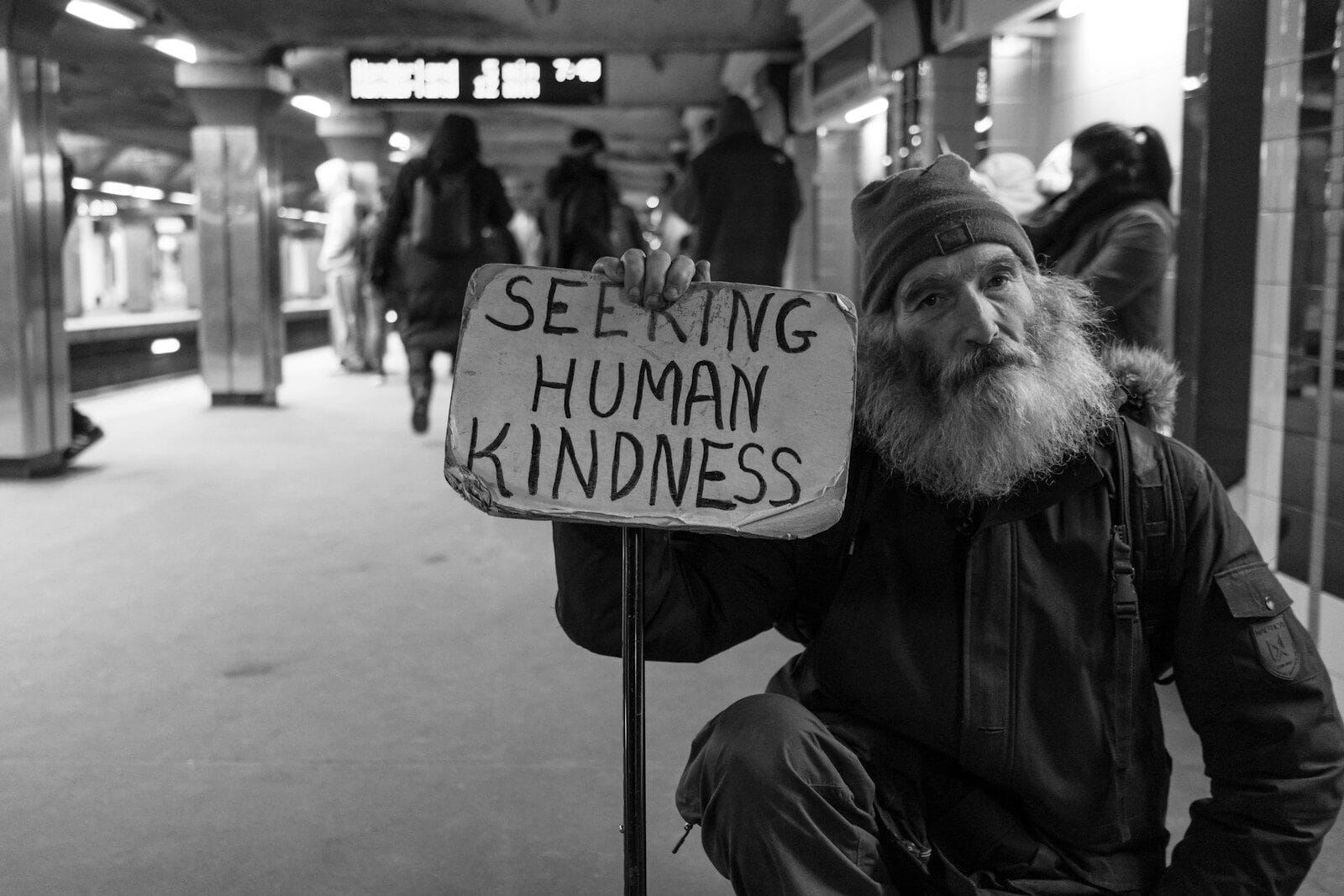
Anyway, the next morning we went for a stroll, and happened upon a homeless man in a wheelchair. To say he was hard to experience is an understatement. His clothing was filthy and shredded. He was slouched over in the chair in a way that was almost corpse-like. His bare feet were grey and red and swollen like watermelons, probably due to edema from liver or kidney failure.
He was passed out, or possibly even dead; I honestly could not tell. And when I got within 10 feet of him, the smell of urine and feces was overwhelming. By any definition, he was, at first impression, repulsive.
And he still haunts me.
Why? Because I passed by and drew conclusions, even if unconsciously, about him without knowing anything about his story. To me, he was, as Scarry would say, seemingly not beautiful. And if he was, how would I ever have known?
I kept walking because encountering the man on a level where I might experience his inner beauty felt like more than I could possibly muster. I recall that even as I walked away, the image of Jesus and the leper kept playing through my mind, reminding me of the giant gap between who I am and who He is. Suddenly, I was the unbeautiful one.
On Stories and Justice
I share this account because it is yet another reminder of why knowing people’s stories matters. Because when we don’t know a person’s story, we risk becoming the greater of Elaine Scarry’s two evils. We risk seeing some beautiful people as unbeautiful, robbing them of the dignity that comes with their true beauty.
Here is another illustration, one with more significant consequences, from the pen of Isaiah:
Who has believed our message? And to whom has the arm of the Lord been revealed? For He grew up before Him like a tender shoot, and like a root out of parched ground; He has no stately form or majesty that we should look upon Him, nor appearance that we should be attracted to Him. He was despised and forsaken of men, a man of sorrows and acquainted with grief; and like one from whom men hide their face He was despised, and we did not esteem Him. – Isaiah 53:1-3.
Unbeautiful For Us
Jesus, the most beautiful example of humanity in His incarnation, became loathsome for our sake. As Paul wrote: He existed in the form of God, but did not regard equality with God a thing to be grasped, but emptied Himself, taking the form of a bondservant, and being made in the likeness of men. Being found in appearance as a man, He humbled Himself by becoming obedient to the point of death, even death on a cross. – Phil. 2:6-8.
Jesus did this for us despite our loathsome, sinful appearance before a Holy God; He saw something beautiful. In fact, not only did He do it despite our unbeautiful condition, but He did it because of that condition. He made no error about our beauty, no matter how unjustified His perspective may have seemed. Jesus saw dignity in the undignified, value in that which seemed worthless, and beauty in the unbeautiful.
Writing a Different Story
The question for you and me is, are we going to be as generous in our response to those who seem to lack beauty as Jesus was to us? Are we going to seek out the hidden beauty in others?
Many years ago, Amy and I started a ministry to help orphaned and vulnerable children in rural South Africa, called 25:40. The name comes from Matthew 25:40, a verse through which Jesus reminds us that whatever we do for the least of our brothers and sisters, we do for Him.
The first time I read this verse, it convicted me deeply, and it still does today. It reminded me to always see Him before me when I look upon another person, no matter how they appear on the outside. Jesus invites us to a new perspective of beauty, which begins by seeing how beautiful we are to Him, despite our outward appearance. When it comes to others, may we embrace it as He did.
